National Museum
The museum that tells you who Norway is
If you want to understand Oslo properly, not just as a capital but as a cultural city with real weight, start at Nasjonalmuseet. This is where Norway brings together art, architecture and design in one place and presents them with unusual clarity, confidence and range. It is central, ambitious and remarkably easy to connect with, even if you are not the sort of person who normally plans a trip around a museum.
Photo: Nasjonalmuseet / Børre Høstland
The Art of Looking Again
Nasjonalmuseet, Oslo | 11 October 2026–1 May 2027
At the edge of Oslo’s harbour, close to the City Hall and Aker Brygge, Nasjonalmuseet poses a question larger than its building: what does a nation choose to remember? Visitors may come for Edvard Munch’s The Scream, yet the museum’s most rewarding journeys often begin one room away from the work they expected to see. Norwegian landscape painting opens onto European ideas about wilderness. A chair becomes a record of changing domestic life. A dress, a woodcut or an architectural model makes familiar history look newly complicated.
The National Museum brings art, architecture, design and craft together at Brynjulf Bulls plass 3. Its present building, designed by Klaus Schuwerk of Kleihues + Schuwerk, opened in 2022. The galleries make it possible to follow several stories at once: the long chronology of the collection, the temporary exhibitions, and the smaller displays through which the museum revisits its own holdings. Its scale rewards a considered route and, if circumstances permit, a return visit.
Between 11 October 2026 and 1 May 2027, the announced programme moves from two exhibitions in their closing days to a reassessment of women painters in Europe, then to the imagined environments of Adrián Villar Rojas and the expansive work of Ole Jørgen Ness. The permanent collection remains the thread running through the entire period. What follows includes the dates on which an exhibition that appears available is actually about to disappear.
The Collection: The Museum’s Continuing Exhibition
The Collection | Throughout the period, during opening hours
Approximately 6,500 works and objects are on view across more than 80 rooms. The first floor traces design and craft from antiquity to the present, alongside painting, sculpture and architecture. Roman portrait busts and the nearly thousand-year-old Baldishol tapestry can be encountered within the same broad history as porcelain, furnishings, royal clothing and contemporary Norwegian fashion. The second floor takes visitors through painting and sculpture from the sixteenth century onwards and into the art of the present. Norwegian work is placed in an international context rather than treated as a sealed national tradition.
For a first encounter with Norwegian art, follow the changing idea of landscape, from early depictions of the country to the paintings of J. C. Dahl, and then ask what happens to that sense of place in the modern rooms. The museum presents Munch’s The Scream among works concerned with human feeling; Hannah Ryggen’s tapestries and John Savio’s prints claim space for different visual languages and histories. Theodor Kittelsen’s fairy tale world offers another route into the stories Norway tells about itself. Contemporary installations by Per Inge Bjørlo and Ilya Kabakov ask the visitor to enter a work rather than simply stand before it; a dedicated gallery considers architect Sverre Fehn.
Design deserves as much attention as the paintings. The objects on the first floor connect artistic choice to use, labour, fashion and status. Queen Maud’s and Queen Sonja’s dress collections, Norwegian furniture and the work of designers including Per Spook make the museum’s larger argument tangible: the things a society makes and wears belong in its cultural history. The museum’s guide to the collection rooms sets out the route: rooms 1–18 cover design before 1900; rooms 19–31, design and craft from 1900 onwards; rooms 33–61, art from 1500–1900; rooms 63–74, art from 1900–1960; and rooms 75–88, art since 1960.
“Permanent” describes the exhibition, not an unchanging display of every object. Works move for conservation, loans and new presentations. The museum’s page on changes in the collection is useful before a visit devoted to a particular artist. One current example is Jumana Manna: Works from Storage in room 87. Manna’s Post Herbarium and Wild Relatives bring questions of botany, land, displacement and preservation into the contemporary galleries. The museum says room 87 will host frequent temporary displays from 2026; its present contents should therefore not be assumed to remain unchanged until May 2027.
The collection extends far beyond the walls. The museum holds around 400,000 works and objects, while approximately 60,000 can be explored through its online collection catalogue. The searchable catalogue is a useful way to prepare for a visit, though a catalogue entry does not establish that a work is currently on display. Book a museum entry ticket for the collection and the temporary exhibitions at the main museum.
Exhibitions in Their Final Days
Mastering the Copy | Final day: 11 October 2026
The guide’s opening day is also the last opportunity to see this exhibition in the Prints and Drawings Gallery. Nineteenth-century artists copied to learn, to circulate images and sometimes to make a new work out of an existing one. Drawings, prints, paintings and sculptures meet copyist registers and other archival evidence of people working before originals in the former National Gallery. A watercolour after Jan van Eyck or a work made in response to an older master is more than a second-hand image: it records what another artist noticed, changed and wished to preserve. For visitors arriving on 11 October, this is the exhibition to see first. Museum admission tickets.
Asta Nørregaard: Truth and Beauty | Until 18 October 2026
Asta Nørregaard’s portraits offer an intimate account of a public world. The sitters include Edvard Munch, Elisabeth Fearnley and women’s rights campaigner Katti Anker Møller; the surfaces of silk, lace and velvet reveal why Nørregaard acquired a reputation as a painter of fashion. Yet the exhibition on the first floor does not reduce her to an accomplished portraitist. Landscapes, interiors, religious works, drawings, sketchbooks and archival material show a career pursued against the restrictions placed on women artists of her generation. Her training in Christiania, Munich and Paris places that career within a wider European field. The exhibition closes on 18 October, making the first week of this guide the last chance to see its full account of an artist whose reputation has been rebuilt. Museum admission tickets.
The Autumn and Winter Exhibitions
W̶o̶m̶a̶n̶ Painter | 8 October 2026–7 February 2027
Around fifty paintings from northern and southern Europe, dating chiefly from 1550 to 1650, bring artists who worked professionally in their own time back into view. Artemisia Gentileschi, Clara Peeters, Lavinia Fontana and Michaelina Wautier appear among the painters; works by teachers help illuminate how an artistic education could be acquired when academies and workshops were largely controlled by men. Portraits, religious painting and still life show the breadth of their ambitions. Developed with the Galleria Borghese in Rome, the exhibition asks not only which women painted, but how success could subsequently vanish from the written history of art.
The title itself, with the word “woman” visibly crossed through, invites a closer look at categories that can diminish an artist even while purporting to identify one. See the work as painting first: attend to the decisions about composition, light and gesture, and then consider the conditions under which those decisions were made. The exhibition continues through the first weeks of 2027, closing on 7 February. Museum admission tickets.
The Pillars | Announced as 2025–2026; precise closing day unconfirmed
In a presentation drawn from the Fredriksen Family Collection, fragmentation becomes both subject and method. Works are cut, folded, sampled and recombined; histories of migration and identity meet the broken rhythms of contemporary media. Firelei Báez, Louise Bourgeois, Mark Bradford, Roni Horn, Simone Leigh, Wangechi Mutu, Shahzia Sikander and Sarah Sze are among the artists represented. Their work gives the room a different pulse from the chronological collection galleries. The museum publishes the date range only as “2025–2026”. It appears in the current programme, but an October or December visit should be checked against the exhibition page, and no showing in 2027 is claimed here. Museum admission tickets.
Adrián Villar Rojas: The End of Imagination | 19 November 2026–7 March 2027
Two of the museum’s Light Halls become the setting for the Argentine artist’s monumental work. Villar Rojas approaches an exhibition as a world responsive to its site: architecture, materials, labour, climate and the passage of time enter the experience. The museum describes this as his first exhibition in Norway and the first major European presentation of his recent work. Expect the question of scale to change as you move through it. Geological time, decay and imagined futures make the human viewer only one element in a larger ecology. A still photograph can show a detail; it cannot substitute for the encounter with the rooms themselves. Museum admission tickets.
Ole Jørgen Ness: Metis | 3 December 2026–29 March 2027
Taking its name from the figure of cunning wisdom in Greek mythology, Metis surveys Ness’s practice from the 1970s to the present. The title points to a kind of intelligence inseparable from making: knowledge learned through the body, the materials at hand and the immediate situation. Among the works is Sketch for a Century, a drawing 26 metres long and reaching the height of the wall, which has not been displayed since 2005. The exhibition also revisits Ness’s long-running attempt to repay his student loan through art, culminating in a gift of 24 works divided between the National Museum and Kode in Bergen. It is a reminder that an artist’s ideas about institutions can themselves become artistic material. Museum admission tickets.
Events and Encounters: October 2026
The following dated events have their own museum pages. Many activity descriptions and booking pages are in Norwegian; international visitors should check the event page for the language of a talk or tour. An ordinary admission ticket does not automatically reserve a place on a limited-capacity tour or a separately ticketed lecture.
Paint Like a Master | 11 and 18 October; 1 and 8 November, 12:00–16:00
Inspired by W̶o̶m̶a̶n̶ Painter, families use large brushes and colours associated with historical painting to work together on a large surface. Visitors can begin a picture or continue one begun by somebody else; the museum turns the old relationship between master and assistant into a game. Drop in at Workshop C. The activity is free for children; accompanying adults need a museum entry ticket. Recommended ages are 3–99.
Teacher Gathering: W̶o̶m̶a̶n̶ Painter | 13 October, 17:00–19:00
An exhibition tour, discussion of teaching possibilities and a practical large-format painting session make this a professional gathering for educators. The museum listed it as sold out at the time of checking; its registration page is the place to look for any change in availability.
Hege Duckert on Katti Anker Møller and Asta Nørregaard | 14 October, 17:30–18:30
Taking Nørregaard’s portrait of Møller as a point of departure, author Hege Duckert connects the lives of the artist and the campaigner to debates about women’s rights around 1900. The auditorium talk was listed as sold out when checked. Consult the event page if availability changes.
Children at the Museum: Active Participation and Co-Creation | 15 October, 09:30–15:30
A professional seminar on how children can participate in museum interpretation rather than merely receive it. Examples span workshops, sensory approaches and work with different audiences. Places are limited; book through the seminar ticket page.
Late Friday: Myth | 16 October, 19:30–23:00
The museum becomes an evening venue with the W̶o̶m̶a̶n̶ Painter exhibition open, short gallery encounters, visuals by Ola Lysgaard and music from Sanyu, Bianca and DJ NASHA. Doors open at 19:30; the first brief exhibition encounter begins at 20:00. Admission is free for visitors aged 18–25 without advance tickets; those over 25 can buy at the door, subject to capacity. The event is for adults aged 18 and over. The museum warns that visual effects may affect visitors with photosensitive epilepsy. Consult the event page for the full running order and door prices.
Audio-Described Tour: Norwegian Design Classics of the Twentieth Century | 17 October, 12:00–12:45
The tour uses verbal description to explore the forms and histories of Norwegian furniture and everyday design. Register at the information desk; a valid museum entry ticket is required.
Halloween Drawing: Spooky Sculptures | 25 October, 12:00–15:00
In the plaster cast gallery, artist Ylva Greni helps visitors draw snakes, monsters and mythological heroes. Drawing materials are supplied. The museum recommends the activity for children aged seven and over; it is included with museum admission.
Shadow Play with Moths and Nocturnal Insects | 25 October, 12:00–16:00
Families make insect forms and explore what light and shadow can do with them in Workshop B. This is a drop-in activity for children from three years old, included with museum admission for adults.
Silva: Scary Insects | 25 October, 13:00, 14:00 and 15:00
Three half-hour sessions invite children to invent nocturnal insects within the interactive Silva forest. The museum gives the age range as approximately 3–12. Ask at the information desk for the Silva place marker; this special Sunday format differs from the ordinary Saturday workshop.
Forum: Hal Foster — Utopia or Extinction? | 27 October, 18:00–19:30
The American art historian and critic asks what might still be recovered from the avant-garde’s union of art and political ambition amid contemporary crises. This auditorium lecture is explicitly listed as in English and has limited capacity. Book the event ticket.
The Line: Drop-In Drawing in the Plaster Cast Gallery | 31 October and 28 November, 12:00–14:00
With Ylva Greni’s guidance, visitors draw among approximately seventy casts that span millennia of sculptural history. No experience is needed, and the museum supplies paper and drawing materials. Arrive at room 2; capacity is first come, first served. The session is included with a museum entry ticket.
Events and Encounters: November and December 2026
Michaelina Wautier: A Lost and Rediscovered Life | 4 November, 17:30–18:30
Curator Simen K. Nielsen follows the change in Wautier’s reputation, from a painter admired in seventeenth-century Belgium to an artist whose life and work had to be recovered. A focused companion to W̶o̶m̶a̶n̶ Painter, the talk is in the auditorium with limited places. Buy an event ticket.
Members’ Tour: A Deeper Look at the Collection | 11 November, 18:30–19:15; 14 November, 12:00–12:45 and 14:00–14:45
A closer view of contemporary art from the 1980s onwards, including questions of fragmentation, social division and installation. These tours are for museum members. Reserve a member place; the museum says places are released 24 hours beforehand.
Handling and Packing Art | 12 November, 10:00–17:30; 13 November, 08:30–15:30
This two-day professional course addresses the practical care of paintings, works on paper, sculpture and objects, from risk and lifting to protective packing. It is taught in Norwegian and requires attendance on both days for a course certificate. Book a course place.
Audio-Described Tour: W̶o̶m̶a̶n̶ Painter | 14 November, 12:00–12:45
An accessible encounter with the exhibition through detailed verbal description. Register at the information desk and obtain a museum entry ticket.
Sign-Language Tour: W̶o̶m̶a̶n̶ Painter | 21 November, 12:00–12:45
The exhibition’s artists and paintings are explored in a sign-language tour. Register at the information desk; admission is required, with the museum’s companion arrangements applying where relevant. Visitors should confirm the sign language used with the museum.
Audio-Described Tour: Christmas Moods in the Collection | 5 December, 12:00–12:45
Religious images, winter landscapes and objects associated with shared meals provide a seasonal route through the collection. Register at the information desk; a museum entry ticket is required.
Members’ Tour: Christmas Special | 12 December, 12:00–12:45 and 14:00–14:45; 16 December, 18:30–19:15
A winter and Christmas themed visit to works in the collection, reserved for members. Book through the members’ ticket page when places are released, 24 hours before each tour.
Guided Tours: The Dated Programme into February 2027
W̶o̶m̶a̶n̶ Painter: Exhibition Tour
The guide follows the artists’ training, careers and subsequent disappearance from parts of art history. Published 14:00–14:45 dates are 18, 20, 22, 25, 27 and 29 October; 3, 5, 8, 10, 12, 15, 17, 19, 24, 26 and 29 November; 1, 6, 8 and 15 December; 3, 5, 17, 24 and 31 January; and 2 and 4 February. Published 18:30–19:15 dates are 20 and 27 October; 3, 10, 17 and 24 November; 1, 8 and 15 December; 5, 12 and 19 January; and 2 February. January and February dates are in 2027. Places are limited; register at the information desk. The tour is included with museum admission, though admission alone does not reserve a tour place.
Women Artists, 1800–1960
This complementary tour takes the question of women’s artistic opportunities into the permanent collection: how education, working lives and expectations changed from the nineteenth century to 1960. Published dates, all 14:00–14:45, are 16, 23 and 30 October; 6, 13, 20 and 27 November 2026; and 8 and 15 January 2027. Register at the information desk with a valid museum admission ticket.
The Whole Nation’s Collection
An introduction to familiar works, newer acquisitions and the reasons a national museum collects and conserves. Published Sunday dates in this period are 11, 18 and 25 October; 1, 8, 15, 22 and 29 November, at 12:00–12:45. Register at the information desk; the tour is included with museum admission.
Art Activism
Works from the collection prompt questions about protest, power and the social possibilities of art. Published dates are 14 and 28 October; 11 and 25 November, 14:00–14:45. Register at the information desk; museum admission is required.
Norwegian Design in the Collection
Chairs, tableware and lighting offer a way to see twentieth- and twenty-first-century Norwegian design in the context of changing habits and ideas. Published dates are 21 October, 4 November and 18 November, 14:00–14:45. Register at the information desk with a museum entry ticket.
Curious About Asta Nørregaard: Truth and Beauty
A short guided encounter with Nørregaard’s work while the exhibition is still open. Published 14:00–14:45 tours are on 13 and 15 October, with an additional evening start at 18:30 on 13 October. Confirm the evening end time on the event page. Register at the information desk with a museum entry ticket.
Baby Tour: W̶o̶m̶a̶n̶ Painter
A gentler paced exhibition visit for adults accompanied by babies, published for 3 November and 1 December, 13:00–13:45. Large strollers may need to be left downstairs. Register at the information desk and bring a valid museum entry ticket.
One Moment: One Work in Ten Minutes
These brief introductions are a good choice when a full tour would take too much of the day. Within the requested period the published October sessions are on 15, 22 and 29 October at 12:00 and 12:30, and 17, 24 and 31 October at 14:00 and 14:30; each lasts ten minutes. The works range from Artemisia Gentileschi and Thomas Fearnley to Munch, a Wedgwood service, Queen Maud’s coronation dress and contemporary art. The event page identifies the selected work for each session and warns that work and time may change. Included with museum admission.
For Families, Independent Visitors and the Curious
Silva, the Primeval Forest
In this interactive workshop, children explore how artists have imagined the forest and then help bring a forest of their own to life. The museum describes family sessions on Saturdays outside official holidays, 12:00–13:30 and 14:30–16:00, for children over three. Its published 2026 workshop listing extends into December; the recurring description should be checked before relying on any particular 2027 Saturday. Reserve a free Silva workshop place, normally released the preceding Friday; accompanying adults also need a museum entry ticket. The Silva workshop is a timed activity with limited places.
The visitor guide app offers an interactive map and audio material for visitors who prefer to set their own pace. The museum also describes activities for independent visitors, including drawing and hands-on ways into the galleries. For children, the fairy tale room within the collection and the spaces for making can turn a visit into something more open-ended than a sequence of framed works.
From January to 1 May 2027: What Can Be Planned Now
The announced winter sequence is clear. W̶o̶m̶a̶n̶ Painter and its currently dated guided tours continue into early February; the exhibition closes 7 February. Villar Rojas remains scheduled through 7 March, and Metis through 29 March. The collection is the continuing exhibition throughout the requested period, subject to the museum’s opening days and changes to individual displays. The published Women Artists, 1800–1960 tours include 8 and 15 January. Silva is described as a regular Saturday activity, but individual spring sessions should be verified before making travel plans.
As of 25 September 2026, the museum pages consulted do not provide a complete separately dated programme for April and 1 May 2027, or confirm what new temporary exhibition may follow the three winter shows. Absence of an announcement now does not mean the galleries will stand empty. The museum’s current exhibitions and events calendar is the appropriate source for newly released spring dates. It would be misleading to present an unannounced exhibition or event as part of an established itinerary.
Planning the Visit
The main museum is at Brynjulf Bulls plass 3, 0250 Oslo, close to the waterfront, the City Hall and Aker Brygge. Use the museum’s visitor information for date-specific hours and any holiday exceptions, particularly at Christmas, New Year and Easter. Buy an entry ticket online for the collection and temporary exhibitions; follow each event’s own booking link where one is provided. Prices and availability can change. The museum lists concessions for visitors under 25 and for students under 30; the latter are purchased at the ticket counter with student identification. Check the free and discounted entry page for current eligibility and the Oslo Pass procedure.
Leave time for the cloakroom and for the distance between galleries. The museum’s practical visitor guide explains bag rules, step-free access, seating and family facilities. A café on the first floor and the Lounge upstairs offer a pause. The National Museum also has other sites in Oslo, including the National Museum – Architecture at Bankplassen 3, with its own opening arrangements. The dated exhibitions and events in this article refer to the main museum at Brynjulf Bulls plass 3 unless an event page explicitly states otherwise.
A good first visit need not be exhaustive. See the temporary exhibition whose closing date is nearest; follow one thread through the permanent collection; then make time for a room you would not instinctively choose. The museum is at its best when the familiar image that brought you in gives way to a new question on the way out.
Research and date check: 25 September 2026. Times are local to Oslo. Further events and changes may be announced after publication.
The museum Oslo had been waiting for
Nasjonalmuseet is not a side attraction or a polite cultural extra. It is one of the defining buildings and institutions in contemporary Oslo. The new museum opened on 11 June 2022 at Brynjulf Bulls plass 3, near City Hall, Aker Brygge and the fjord, and brought together collections that had previously been spread across the National Gallery, the Museum of Contemporary Art, the Museum of Decorative Arts and Design, and part of the Museum of Architecture. That move matters. It means the museum does not feel fragmented. You are not moving between disconnected departments; you are moving through a fuller national story.
This is also why the museum feels so convincing. It does not present Norwegian culture as a narrow historical tale or a parade of masterworks. Instead, it shows how painting, furniture, textiles, architecture, craft and contemporary design all speak to the same questions: what kind of country Norway has been, what it values, and how it wants to be seen now. That breadth is one of Nasjonalmuseet’s greatest strengths.
A building with proper Oslo confidence
The building itself gets the tone exactly right. Designed by Klaus Schuwerk of Kleihues + Schuwerk, the museum is large, calm and self-assured rather than showy. It has a total area of 54,600 square metres, with major spaces for both permanent and changing exhibitions, and it was conceived not just as a home for art but as a public place within the city. That is why it works so well. It does not sit outside Oslo; it participates in Oslo.
There is something deeply fitting about its material language too. The museum carries a sense of Nordic solidity without becoming severe. Inside, the scale is generous but not exhausting. Outside, the setting by the waterfront gives the whole institution more air and light than many national museums manage. And then there is the Light Hall, the museum’s signature upper-level exhibition space: 2,400 square metres of luminous architectural ambition that gives temporary exhibitions a seriousness and presence they might not have elsewhere.
More than a museum for people who “like museums”
The clever thing about Nasjonalmuseet is that it is legible. Serious, yes. Dense with meaning, absolutely. But never wilfully obscure. You do not need specialist knowledge to get something out of it. The museum is built for first-time visitors, curious locals, art lovers and people who simply want one excellent cultural stop in central Oslo. The routes through the galleries are varied, the objects are presented across periods and disciplines, and the institution has clearly been designed to accommodate different levels of attention and different kinds of visitor.
That makes it one of the most useful museums in the city. You can spend a focused ninety minutes here and feel enriched, or give it half a day and still leave with more to come back for. It is both a strong first visit and a museum that rewards repeat visits, which is rarer than it should be.
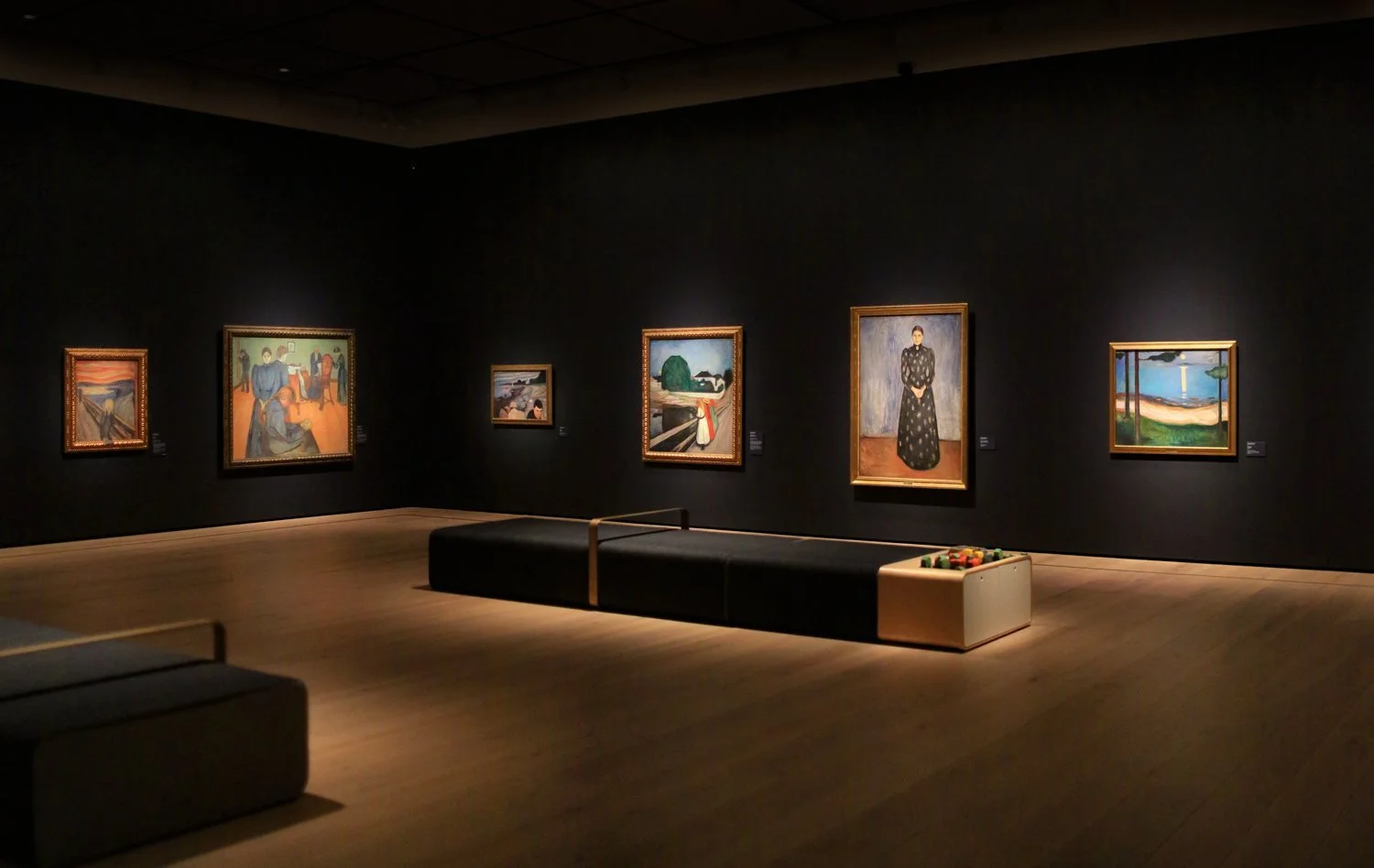
Yes, The Scream matters — but it is not the whole story
For many visitors, Edvard Munch is the magnetic pull, and rightly so. Nasjonalmuseet holds one of the most important Munch collections in the world, including The Scream from 1893. It remains one of the great cultural icons in Norway, and seeing it in person still lands with real force. Not because it is famous, but because the work itself is so emotionally precise, so visually unstable, so alive.
But one of the best things about Nasjonalmuseet is that it refuses to become a one-work museum. You may come for Munch and leave talking about architecture, Norwegian design, decorative arts, modern painting or an object you had never heard of before. The museum’s collection stretches from antiquity to the present day, and its online collection alone includes more than 50,000 works. That scale changes the visit. It turns what could have been a trophy stop into a broader encounter with how a country sees beauty, history, public life and itself.
Why it feels so right in Oslo
Some museums are important but oddly detached from the place around them. Nasjonalmuseet is not like that. It feels anchored in Oslo’s current identity: outward-looking, design-aware, culturally serious, increasingly international, but still comfortable with understatement. The museum square, the nearby waterfront, the view lines towards City Hall and the harbour, the movement of people through the area — all of it gives the institution a distinctly urban life. It is one of the clearest examples of Oslo getting the balance right between civic space and cultural ambition.
That is why it suits so many kinds of visitor. It works for travellers who want a major museum experience, for locals who want to spend an afternoon somewhere substantial, and for anyone trying to understand what modern Oslo has become. It is not old-fashioned prestige culture. It is something better: a museum that feels fully used, fully public and fully part of the city around it.
How to visit it well
The best advice is simple: do not rush it. Give the museum enough time to unfold. Walk the building properly. Notice how the spaces change. Let yourself move between large national narratives and smaller, stranger details. And do not make the mistake of treating it as a place to “tick off” before heading elsewhere. Nasjonalmuseet is the elsewhere. It is one of the places in Oslo where the city becomes most readable.
If you are planning around practicalities, the museum’s official visitor information is the right place to check tickets, opening details and current access information before you go. But editorially, the stronger point is this: if you only have room for one major museum in Oslo, make it Nasjonalmuseet. It gives you the widest frame, the clearest sense of place and one of the most satisfying cultural experiences in the city.
Final word
Nasjonalmuseet succeeds because it does not try too hard to impress. It simply has the weight, quality and confidence to stand where it stands. It is national without being stiff, contemporary without being fashionable, and ambitious without losing the visitor. For Oslo, that makes it more than a museum. It makes it one of the city’s clearest statements about who it is.
The National Museum collection
The National Museum exhibits Norway's largest collections of art, architecture and design. The National Museum was established as an institution in 2003, as a result of the consolidation of the National Gallery, The Museum of Architecture, the Museum of Decorative Arts and Design and the Museum of Contemporary Art.
Opening hours
Day of weekOpening hours this weekSunday, Monday, Thursday, Friday and Saturday10–17Tuesday and Wednesday10–20
Holidays and exceptions
Regular opening hours
Monday: 10–17
Tuesday: 10–20
Wednesday: 10–20
Thursday: 10–17
Friday: 10–17
Saturday: 10–17
Sunday: 10–17
Exceptions
Christmas holiday (24.–26. december): Closed
New Year's holiday (31. december 2026 – 1. january 2027): Closed