Vigeland Museum
This museum is dedicated to Gustav Vigeland, Norway’s most famous sculptor, and is housed in his former studio and home near Vigeland Park. It presents early works, portraits, monuments and, crucially, the original plaster models for the sculptures in Vigeland Park.
INTRO
The Vigeland Museum opened in 1947 and is Gustav Vigeland's former studio and residence. Today, the museum shows a permanent exhibition presenting Vigeland's art, and temporary exhibitions with three-dimensional art.
The building, which is one of Norway's foremost examples of neoclassical architecture, is designed by architect Lorentz Ree.
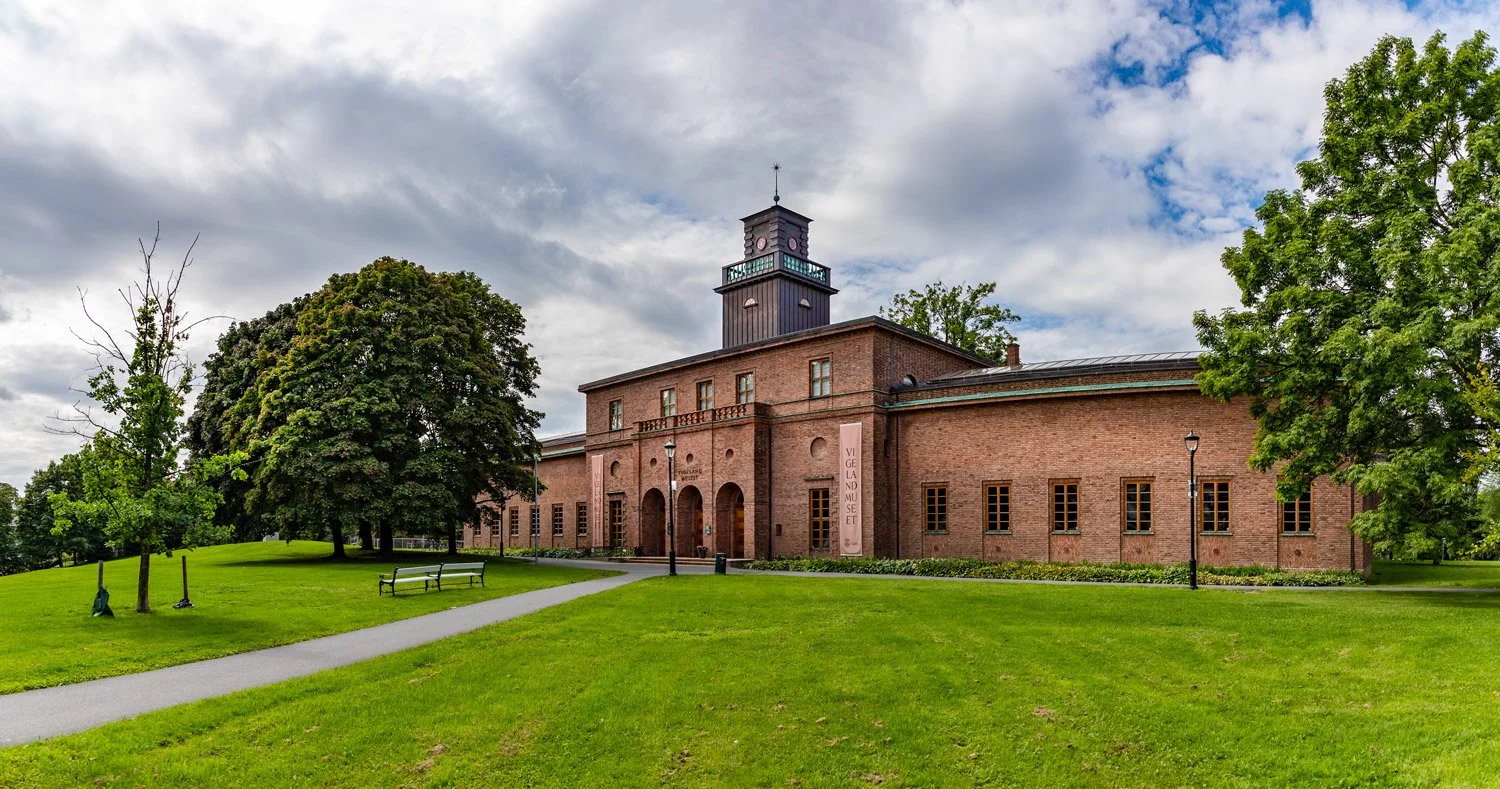
The Vigeland Museum
In 1919, the City Council in Oslo decided to build a new studio for Gustav Vigeland at Frogner. The final contract, signed in February 1921, stated that Vigeland would bequeath all his works to the City Council in return for the right to continue using the studio until his death. It was also decided that the studio would become a museum to house Vigeland’s works after his death, and to build an apartment on the 2nd floor of the building.
In 1924 Vigeland moved into the apartment at Frogner where he was to lead a quiet and uneventful life with his wife Ingerid. He was completely absorbed by his work and was seldom seen outside the studio. In the evenings he preferred to sit in the library drawing, reading or making woodcuts.
Vigeland was associated with many highly skilled craftsmen; both plaster casters, stone masons, and smiths. The number of craftsmen in residence varied depending on his needs. They helped build the iron armatures inside the sculptures and roughly covered the larger sculptures with clay according to the sketches. His assistants also carried out plaster casting and stone masonry. The efforts of these assistants were decisive for the realisation of the Vigeland Park.
Vigeland lived at Frogner until his death in 1943. His studio was reopened as a museum in 1947. At present the museum has approximately 1,600 sculptures, 420 woodcuts and 12,000 drawings, in addition to a collection of the artist’s notebooks, several thousand letters and his large library and collection of photographs.
ARCHITECTURE
As soon as the contract between Gustav Vigeland and the City of Oslo was signed in February 1921, the construction work began at Frogner. Architect Lorentz Harboe Ree (1888-1962) had been commissioned to design the building.
Vigeland started to doubt Ree's competence early on, reacting to the architect's fluctuation between different styles. Ree faced a challenging task, but despite disagreements with Vigeland, he managed to create architecture of high quality. The building, with its monumentality, proportions, and discreetly adapted details, ranks among the main works of neoclassicism in Norway.
Vigeland's specific request for hand-beaten red brick in the exterior was taken into account, and the tower received an interior circular room and an exterior balustrade. The south wing, intended for the studio and workshops, was delayed due to insufficient funds as the building turned out to be considerably more expensive than initially estimated. The south wing was completed in 1929 and turned out to be very different from the rest of the building due to the emergence of a new architectural style in Norway: Functionalism. This architectural style brought new solutions, with Ree designing large windows framed with thin iron window bars, and all decorative details were omitted.
In 1926, architects Ree and Buch were awarded the Houens Fonds Prize for good architecture. Carl Emil Buch (1892-1968) became Ree's partner in 1920, but Ree had the primary responsibility during the construction process. The building was completed in 1929.
THE ARTIST HOME
Ingerid and Gustav Vigeland's appartment
The Vigeland Museum was built in the 1920s by the City of Oslo as a studio, residence and future museum for the Norwegian sculptor Gustav Vigeland. Norway's great sculptor worked and lived here for the last 20 years of his life, until his death in 1943. The building was started in neoclassical style and this style characterizes the north wing. However, the building was not completed until 1931 and completed in a functionalist style. Architect Lorentz Ree received the Houen Foundation's award in 1926. The museum is today considered one of Norway's most beautiful with its exquisite colors and light from the skylights.
Gustav Vigeland and his wife Ingerid moved in to the apartment in 1924. The apartment is in the third floor of the museum and is nearly 300 square meters, with two living rooms, a dining room, one bedroom, a big library, kitchen and a modern bathroom.
The interior of Ingerid and Gustav Vigeland's apartment was designed by Vigeland himself. The lamps, pillows, fabrics and tablecloths can be considered a "gesamtkunstwerk" inspired by the Art & Crafts movement.
See the film about Ingerid and Gustav Vigeland's Artist House here: Vigeland's apartment. The film is in Norwegian, but the subtitles can be set in another language.
Guided Tour of Vigeland's Artist Home?
Vigeland's Artist Homeis only accessible by appointment or during public tours. Dates for public tours of the artist home can be found under events. Please note that most of the public guided tours in the apartment are held in Norwegian.
If you wish to have a private guided tour of Vigeland's Artist Home, please contact marte.grette@kul.oslo.kommune.no. See our prices for private guided tours here.
THE COURTYARD
The Courtyard is the heart of the Vigeland Museum. In the midst of the museum's 13 halls, you will find a beautiful outdoor space surrounded by elegant colonnades. At its center stands a fountain, encircled by a number of sculptures that contribute to the unique atmosphere of the place.
During the summer season, the Courtyard is open to the public, and we highly recommend making a visit here when you come to the museum. Sit down, close your eyes, and enjoy the sound of the trickling water from the fountain or the wind rustling through the majestic tree. It is the perfect spot for a relaxing break.
In the summer season, the Courtyard transforms into a lively outdoor stage for our summer concerts—a concert venue filled with history and charm, offering truly unique musical experiences!
THE SKETCH ROOM
Gustav Vigeland modelled approx. 800 sketches in clay over the course of his lifetime, some of which are exhibited in these two rooms. Among the sketches are designs for monuments and fountains, animals, anatomical studies and several groups of figures, some later executed in large scale. Vigeland often rapidly transmitted ideas directly in clay without previous drawings and without the use of live models. He considered the sketches an important part of the creative process and they give evidence of his rich imagination.
Address: Nobels gate 32, 0268 Oslo. Opening hours: Tue–Sun 12:00–16:00, with extended summer hours in June, July and August: 10:00–17:00.