Akrobaten Pedestrian Bridge
Oslo’s Elegant Crossing Above the Railway Tracks
Akrobaten is one of those urban places that reveals Oslo in a single, memorable movement. Suspended above the railway tracks at Oslo Central Station, the bridge carries pedestrians and cyclists between Grønland and Bjørvika, between the older city and the new waterfront, between everyday infrastructure and contemporary architecture.
With its steel-and-glass structure, dramatic lines and exceptional views towards Barcode, Akrobaten has become both a practical city connection and one of the most distinctive modern viewpoints in central Oslo.
Akrobaten is not a bridge one simply uses. It is a bridge one experiences.
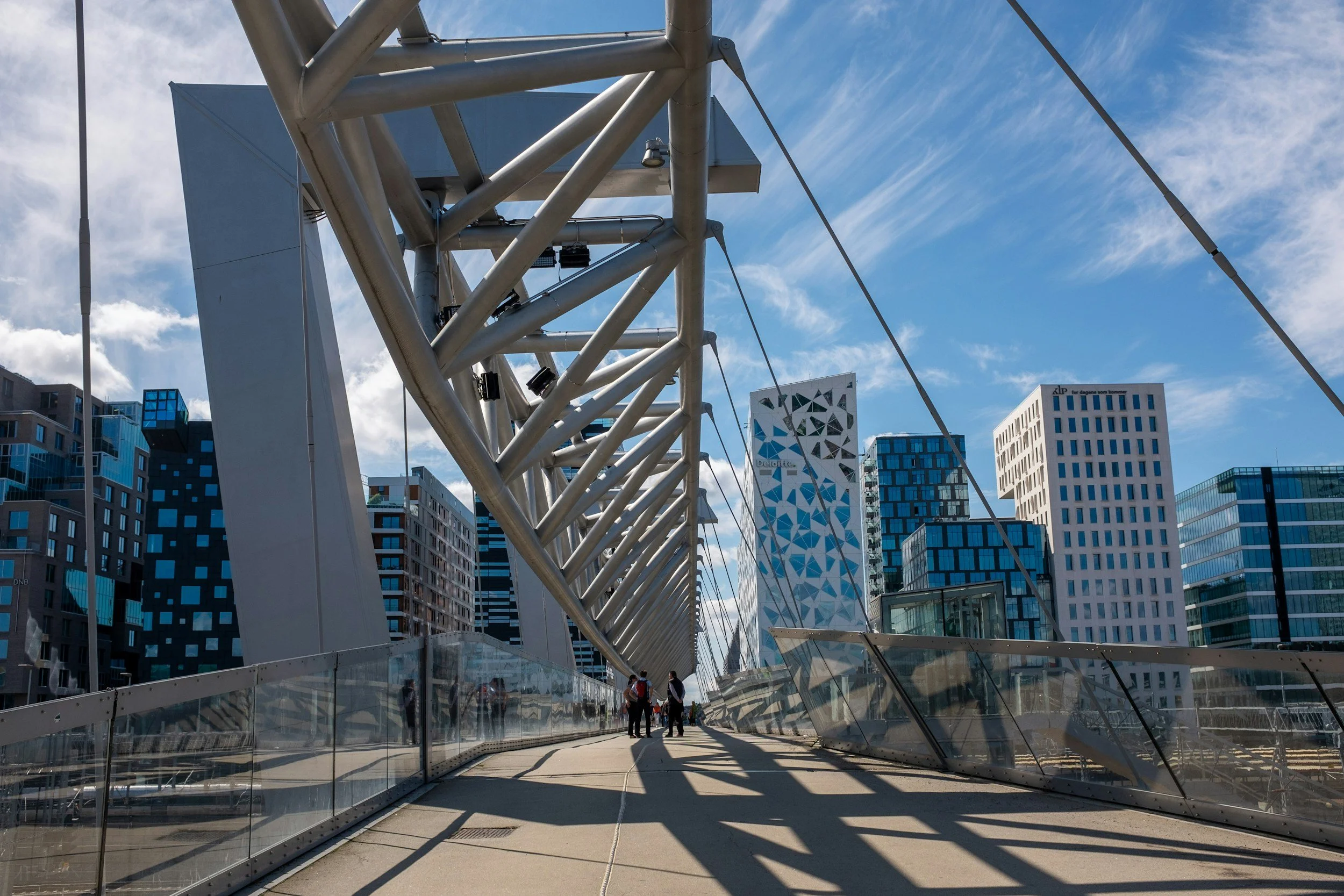
Set in the dense, kinetic landscape around Oslo Central Station, it crosses one of the busiest and most complex pieces of infrastructure in Norway. Beneath it, trains slide in and out of the station. Around it, the city shifts character: Grønland with its layered urban life on one side, Bjørvika and Barcode with their sharp architectural profile on the other. The bridge is approximately 206 metres long and links Grønland with Bjørvika across the railway tracks at Oslo S. It opened in 2011 and was designed by L2 Arkitekter and Rambøll Norge.
A Bridge Between Two Versions of Oslo
Akrobaten is one of the clearest places in the city to feel Oslo’s transformation. To the south and west lies Bjørvika, the former harbour and traffic zone that has become one of Scandinavia’s most ambitious waterfront districts. Here you find Barcode, Dronning Eufemias gate, the Opera House, Deichman Bjørvika, MUNCH and the open spaces leading towards the fjord.
To the north and east, the city changes rhythm. Grønland, Tøyenbekken and the streets around Schweigaards gate belong to a denser, older and more socially varied Oslo — a district of shops, cafés, everyday life, migration histories, small businesses and layered urban culture.
Akrobaten makes the physical distance between these districts short. More importantly, it makes the transition visible. In only a few minutes, you walk from one Oslo into another: from the city of railway lines and neighbourhood streets to the city of glass towers, cultural landmarks and fjord-facing urban design.
Architecture in Motion
The name Akrobaten — “the Acrobat” — is unusually apt. The bridge has a poised, almost athletic quality. It appears to stretch, balance and hold itself above the tracks with controlled tension. Its steel structure, suspended deck and glass railings give the crossing a sense of lightness, even though the engineering challenge behind it is considerable.
L2 Arkitekter describes Akrobaten as a pedestrian and bicycle bridge crossing 19 electrified railway tracks at Oslo Central Station, with stairs and lifts connecting down to the station platforms. Structurae lists it as a steel truss bridge with a suspended deck, a total length of 206 metres, a width of 6 metres and a main span of 67 metres.
What makes the bridge special is the way these technical facts become visual drama. The structure is not hidden. It is the architecture. Steel, glass, cables and angles are allowed to define the experience. The result is a bridge that feels urban, open and precise — a piece of infrastructure with the confidence of a landmark.
One of Oslo’s Best Modern Viewpoints
For visitors, Akrobaten is a superb place to see modern Oslo at close range. This is not a distant panorama from a hilltop; it is an immersive city view from inside the machinery of the capital.
From the bridge, you look directly across the railway tracks towards Barcode and Bjørvika. The lines of the tracks, the movement of the trains, the vertical rhythm of the high-rises and the reflections in the glass façades create one of Oslo’s most cinematic urban scenes. NLI describes the bridge as a 206-metre steel-and-glass structure known for its views of Barcode and its colourful lighting after dark.
During the day, Akrobaten offers clean architectural perspectives. In the evening, it becomes more atmospheric, with artificial light, passing trains and the illuminated skyline of Bjørvika. For photographers, it is one of the most rewarding places in central Oslo: graphic, accessible, distinctly urban and unmistakably local.
From Infrastructure to City Space
The most successful urban bridges do more than solve a movement problem. They create a place. Akrobaten does exactly that.
The railway tracks around Oslo S could easily have remained a hard barrier between neighbourhoods. Instead, the bridge turns the crossing into an experience. It gives pedestrians and cyclists a generous route over a difficult urban gap and, at the same time, offers a new way of reading the city.
This is why Akrobaten matters. It belongs to the everyday city — commuters, cyclists, travellers with luggage, people walking between meetings, residents moving between districts — but it also carries a larger symbolic meaning. It shows how Oslo has used architecture to stitch together areas that were once separated by railway, road and industrial infrastructure.
Award-Winning Steel Design
Akrobaten has also received international professional recognition. In 2012, the bridge won first prize in the pedestrian and cycle bridge category at the ECCS European Award for Steel Bridges, an award celebrating outstanding steel and composite bridge structures in Europe.
That recognition is easy to understand. Akrobaten is not simply attractive; it is a complex piece of urban engineering placed in an unusually demanding location. It had to cross active railway tracks, land naturally in dense city spaces on both sides, serve pedestrians and cyclists, and integrate access to station platforms. The result is both functional and memorable.
A Short Walk with a Strong Sense of Place
Akrobaten is ideal to include in a walk through central Oslo. A particularly rewarding route begins at the Opera House or Deichman Bjørvika, continues through Barcode, crosses Akrobaten and then leads into Grønland. In less than half an hour, this walk gives visitors a compact but vivid impression of the city’s contrasts: fjordfront architecture, national infrastructure, new development, older neighbourhood streets and everyday Oslo life.
It also works in the opposite direction. Starting in Grønland and crossing towards Bjørvika, Akrobaten becomes a gradual reveal: first the railway landscape, then the high-rises, then the open axis towards the fjord. For first-time visitors, this is one of the simplest ways to understand how Oslo has expanded eastwards and down towards the water.
Practical Information
Name: Akrobaten Pedestrian Bridge
Location: Above the railway tracks at Oslo Central Station
Connection: Between Grønland and Bjørvika
Opened: 2011
Length: Approximately 206 metres
Main span: Approximately 67 metres
Width: Approximately 6 metres
Architects and engineers: L2 Arkitekter and Rambøll Norge
Use: Pedestrian and bicycle bridge
Best for: Architecture, photography, city walks, views of Barcode and Bjørvika
Nearby places: Oslo Central Station, Barcode, Dronning Eufemias gate, Deichman Bjørvika, the Opera House, Grønland and Vaterland
Why Akrobaten Is Worth Seeing
Akrobaten is not one of Oslo’s grand historical monuments, and that is precisely part of its appeal. It belongs to the modern city: practical, engineered, elegant and alive with movement. It is a bridge for commuters and travellers, but also for architecture lovers, photographers and visitors who want to understand Oslo beyond the obvious landmarks.
Standing on Akrobaten, you see the capital in transition. You see trains, glass towers, old neighbourhoods, new streets, commuters, cyclists, steel, light and sky. You see how Oslo has become a city that no longer turns its back on its infrastructure, but uses it as part of the urban experience.
Akrobaten is a short crossing. But in the story of modern Oslo, it is a highly expressive one.