Upcoming Events
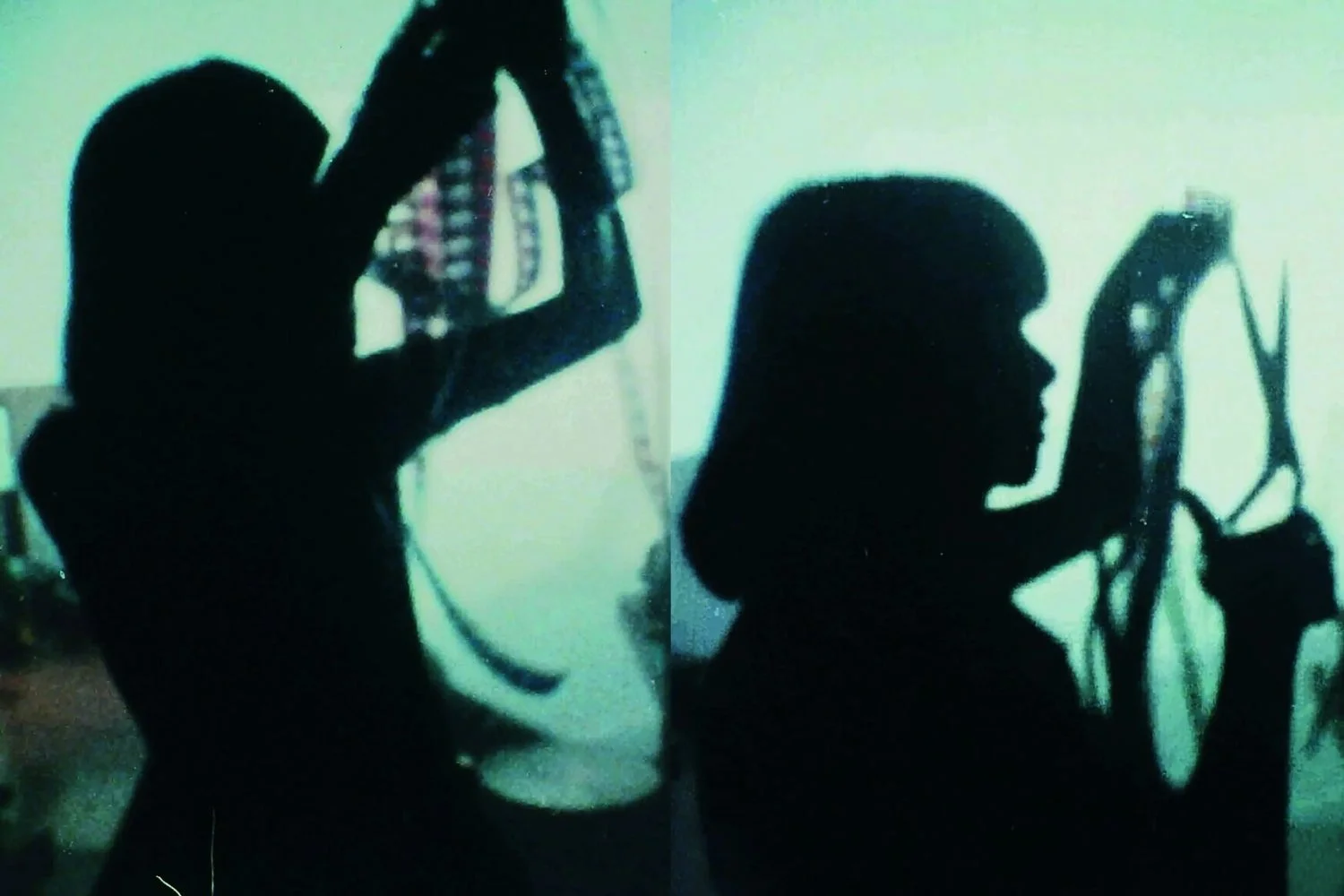
No Master Territories
Bridging the fields of documentary and experimental film and video….
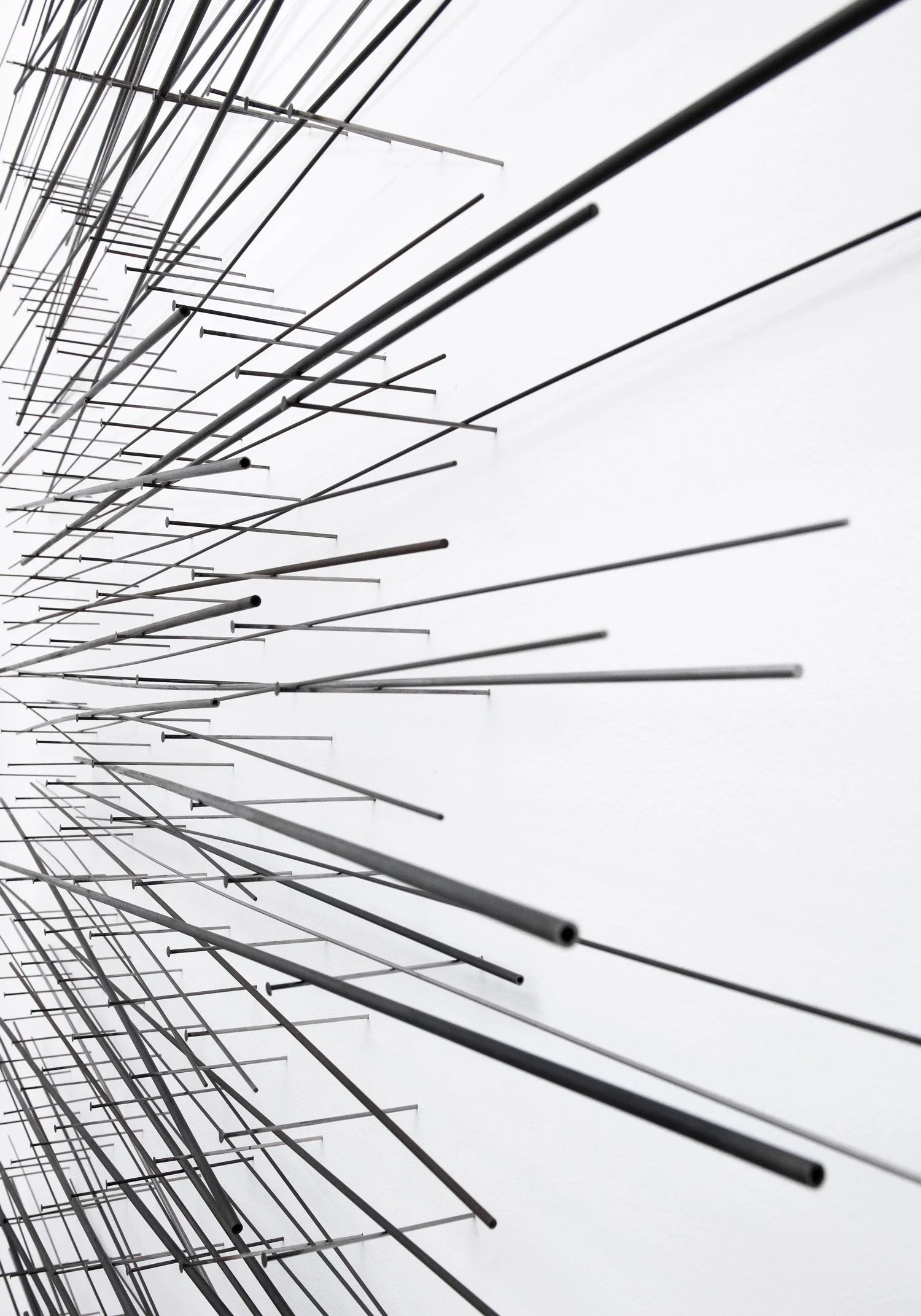
Tone Vigeland / Sculptures, Installation and Objects
Tone Vigeland (1938-2024) was one of Norway’s most recognized artists of her generation.
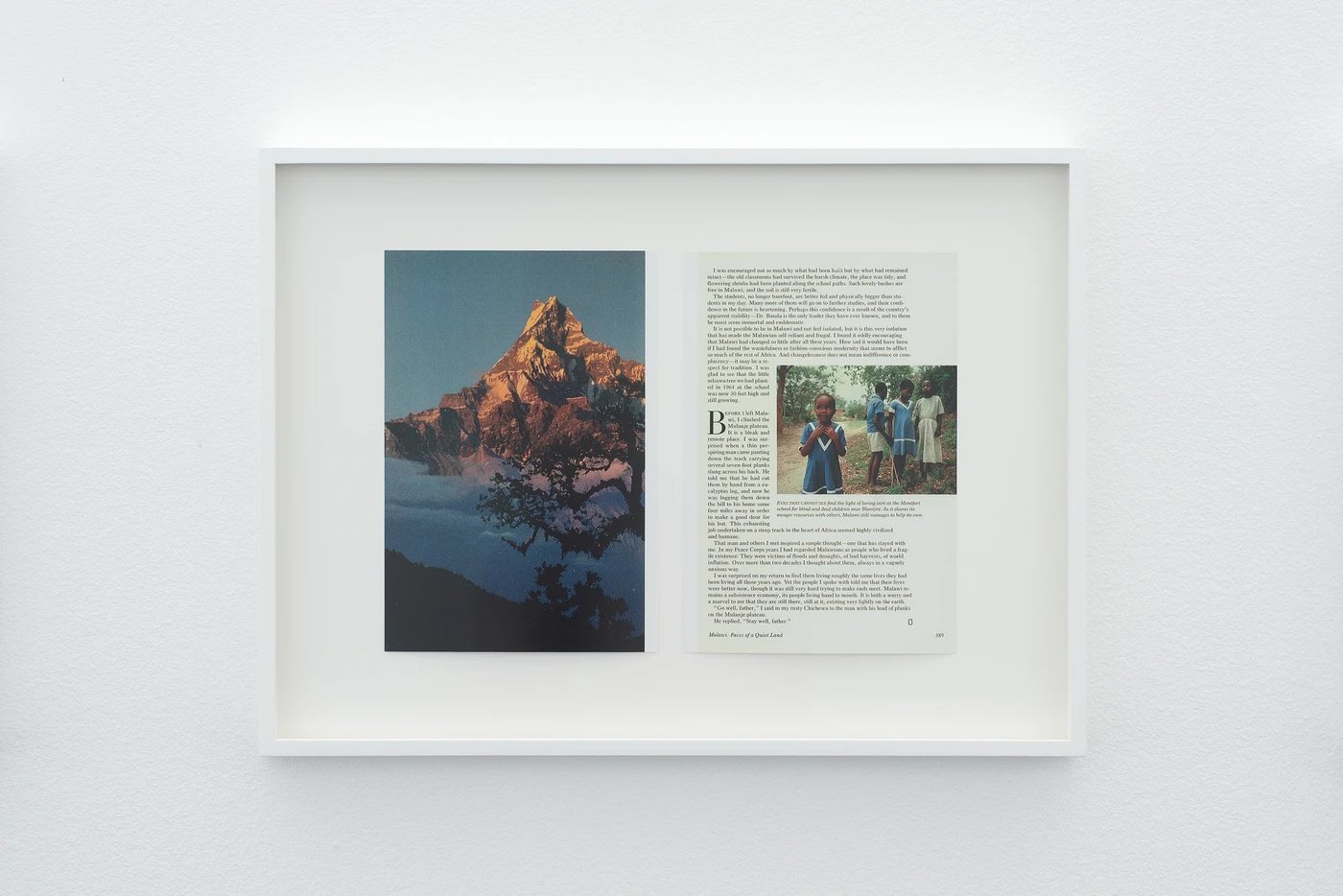
Lisa Tan - National Geographic (Epoch)
Her work is imbued with personal narrative and marked by material and conceptual precision….
Jone Kvie - Time Machines
The exhibition time machines by Norwegian artist Jone Kvie at OSL contemporary continues the artist’s long-standing exploration of a forgotten vision of the world and the forces that govern it.
In this pre-rational cosmology, the living realm is animated by elemental forces—fire, air, water, and earth—moved by Love and Strife rather than abstract laws. Knowledge arises not through mastery or measurement, but through attunement to circulating forces and their instabilities. Moving between this ancient understanding of the laws of nature and modern sculpture—through a search for sensuality within mineral matter and the staging of gravity as a sculptural principle—Kvie’s practice runs counter to the technical processes that have reduced the primordial energies of things and beings to mere mathematical curves. Added to this fracture between the ancient and the modern is a life held in balance between Stavanger—city of the petro-titans—and Naples, cradle of the Baroque, whose horizon is dominated by the fiery lung of Mount Vesuvius. Whether by chance or through a secret fascination with what erupts, Jone Kvie’s trajectory led him to live close to gaping, burning gateways to the lower terrestrial circles. After five years in Naples, the artist has recently returned to Stavanger. The exhibition thus takes the form of a portrait of Naples, a palimpsest city where history and mythologies have sedimented in flesh as much as in rock, while also bringing together the visions of an artist who himself became lost in a Grand Tour lasting nearly a decade.
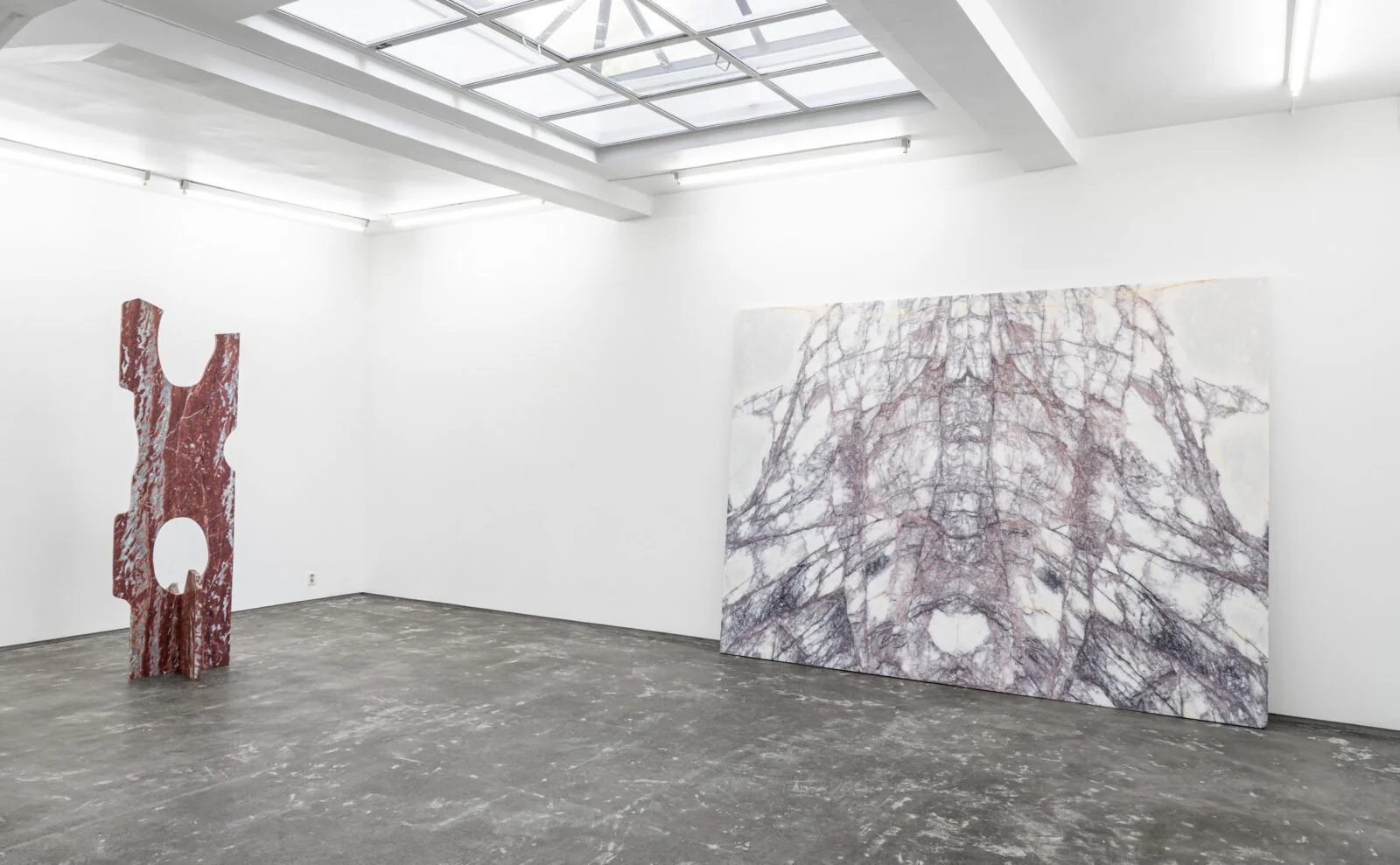
The exhibition opens with body, a massive volcanic rock resting on multiple metal beams. Blocking the passage, the work forces the visitor to step over it, inverting Michael Heizer’s gesture which, with Levitated Mass (2012), allowed the viewer to circulate beneath a titanic rock mass. The exhibition’s center of gravity, body, links minimalist asceticism to a premodern tradition of thought, in which the subject/object distinction had not yet flattened our relationship to existence. The world was then populated by energies inseparable from affects. In this sense, the work—apparently static—is in fact engaged in a permanent search for balance: its stability depends solely on the distribution of its mass across the beams. Echoing the reflections of the pre-Socratic philosopher Empedocles, whose passion for fire led him to throw himself into the mouth of a volcano, Jone Kvie seems to have drawn upon cosmogonic visions from a time when the stars spoke the language of forbidden deities.
In Flesh and Stone (1996), American sociologist Richard Sennett describes the passage from the carnal, embodied, and chaotic city to the hygienic, regulated, and automated modern metropolis. If, today, the former has largely dissolved into the latter, time machines celebrates the city as a constellation of erogenous zones where affects and intensities collide. To grasp the intimate relationship each city maintains with its inhabitants, one need only observe how cities personify themselves through canonized urban figures that crystallize postures and attitudes: London and the dandy, Paris and the flâneur, and of course Naples and Pulcinella. An embodiment of moral ambiguity, the latter appears in Mask (2025), a monumental sculpture in gray marble reproducing the sly face of the commedia dell’arte anti-hero, an emblematic figure of the Campanian city. The sculpture’s form also refers to one of humanity’s earliest gestures of concealment: the dancing shaman, a parietal figure from the Trois-Frères cave in Ariège, France. By tracing a history of the mask from prehistoric art to the Renaissance, a genealogy of humanity as an act of usurpation emerges.
The portrait of Naples continues with two phallic marble sculptures that originally formed a portico, salthour (2025). Laid horizontally and deprived of the vertical authority that once allowed them to mark the passage from public to private space, they acquire a new meaning through their title. salthour proposes a poetic measure of time, situated at the intersection of biological time and geological history, through the dual nature of salt as both a preservative and a corrosive agent. By associating this material with the notion of the “hour”, Jone Kvie suggests that time is not merely a human convention but a physical process inscribed in our bodies as much as in earthly matter.
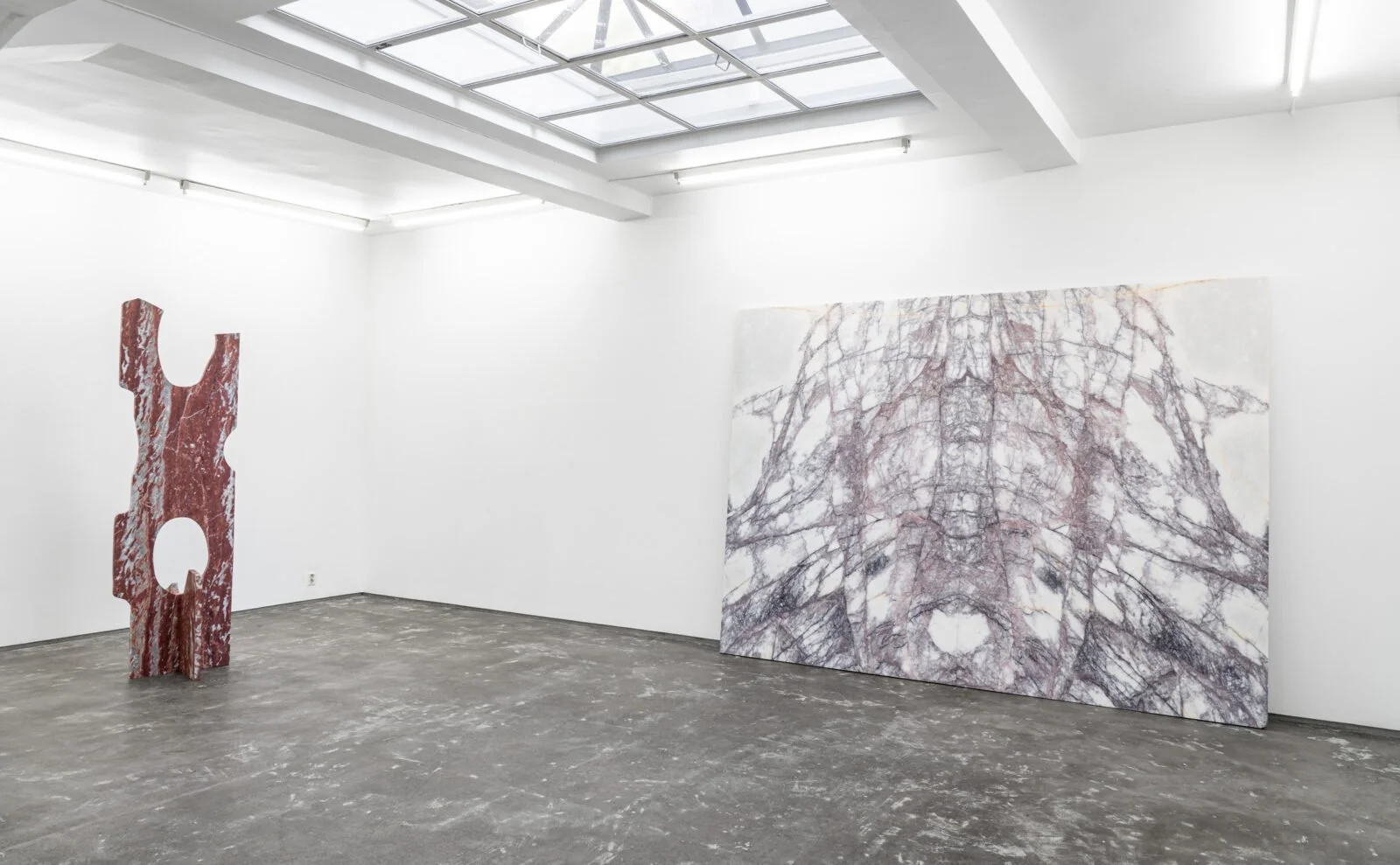
With Detritus (2025), the exhibition opens onto a metaphysical comedy. Composed of a long bathroom countertop in Rosso Francia marble, autonomous and pierced by two openings deprived of their sinks, the sculpture diverts marble—arte povera’s material par excellence, historically used to evoke eternity—by suspending its primary function. The work also cultivates a bodily ambiguity: its polished surface, red and veined with white, evokes glistening flesh. In Kvie’s work, marble conjures up the sensuality of its ancient use, favored for capturing heroic contours or the vulnerability of a chest. Here, however, far from any mannerism, the artist substitutes a cold, almost clinical cut.
Finally, the exhibition concludes with revenant (2025). Composed of two slices of gray marble arranged as mirror images in the manner of a Rorschach test, the work refers to the very process of the material’s sedimentation: an accumulation of animal carcasses compressed over millions of years, an inhuman time irreducible to the individual scale. Stripped of all ornamentation, these sculptures act as an anatomical cross-section of time, confronting the viewer with the impossibility of grasping its depth except through weight, mass, and precarious balance.
time machines subtly explores the figure of the artist as a Pulcinella-like character, wielding ambiguity, ambivalence, and false appearances as method. The absurdity of the human condition is revealed through the use of geological time—counted in millions of years—mobilized to adorn bourgeois bathrooms. It is perhaps in this negotiation with unbearable scales of magnitude that the banal, whether interior decoration or, to a lesser extent, a work of art, acquires its critical charge. With a distinctly Neapolitan sense of irony, Jone Kvie invites us to move among sculptures in volcanic rock or marble—the latter a quintessential memento mori substance—in which our material destiny is reflected without embellishment.
“Nothing is lost, nothing is created, everything is transformed.”
Apocryphal citation of Antoine Lavoisier, Traité élémentaire de chimie (1789).
– by Charles Teyssou
Jone Kvie (b. 1971, Stavanger) lives and works in Naples and Stavanger. His practice as a sculptor is characterised by a fascination with existential questions, and by an intention to extend the notion of art towards contemplation over the world’s being, and what it means to be human in it. Our will to know and interpret the “natural world” is reflected in Kvie’s attention to cultural interpretations, archetypes and myths, and finally in his choices of themes, form, materials and titles. Often taking on the unfathomable and unknown as his subject matter, his sculptures may be read both as reflections on our attempts to understand and as physical manifestations of the ideas that are created in these attempts. Mental and abstract conceptions become objects with independent existence, often appearing surprisingly recognisable in their firm presence.
Kvie has exhibited extensively, including ARoS Art Museum (Aarhus), The National Museum, Kunstnernes Hus (Oslo), Bergen Art Museum, Malmö Art Museum and Gothenburg Museum of Art.
Highlights include his solo exhibitions Vessels at the Vigeland Museum in Oslo (2017), Metamorfos at the Gothenburg Museum of Art (2018), and Here here at Stavanger Kunstmuseum (2019).
He has been involved in several public and private commissions, and is represented in key public and private collections including Corcoran Museum (Washington DC), AROS (Aarhus); The National Museum of Art (Oslo), The National Public Arts Council (Stockholm), Malmö Art Museum, Kode Bergen, Stavanger Kunstmuseum, in addition to a permanent installation at the Gothenburg Museum of Art.
In 2022, Kvie participated in documenta fifteen in Kassel, Germany, and was part of a group show in Kunsten Museum of Modern Art, Aalborg, Denmark. He also presented a solo exhibition what comes after certainty at Örebro konsthall, Sweden. In 2025, he was part of the group exhibition Apocalypse: From Last Judgement to Climate Threat at the Gothenburg Museum of Art.
Kvie is a member of LABINAC, a design collective founded by Maria Thereza Alves and Jimmie Durham.
Charles Teyssou is a curator based in Paris and the artistic director of Stavanger Secession in Stavanger, Norway. He is currently working on the release of Cruising Pavilion: Architecture, Dissident Sex, and Cruising Cultures, a publication on homosexual cruising, published by HEAD (Geneva) and Spector Books (Leipzig).
O S L contemporary
OSL contemporary was established in 2011 by Emilie Magnus. Located in a former fire station in Oslo’s West End, the gallery has since developed an extensive program, currently representing twenty-three emerging and established artists encompassing a diverse range of disciplines.
With the focused initiative to nurture the artists’ positions within the Nordic region and promote their practice to a wider global audience, the gallery works closely with local institutions and museums whilst continuously engaging and participating in projects, exhibitions, and art fairs internationally.
Opening Hours
Tuesday - Friday, 12-17.00
Saturday, 12-16.00
Address
OSL contemporary
Haxthausens gate 3
0263 Oslo, Norway
MARTINE POPPE - The Weight of Water
ISCA gallery is delighted to present The Weight of Water, a solo exhibition by Martine Poppe featuring a new series of paintings exploring water as a central motif.
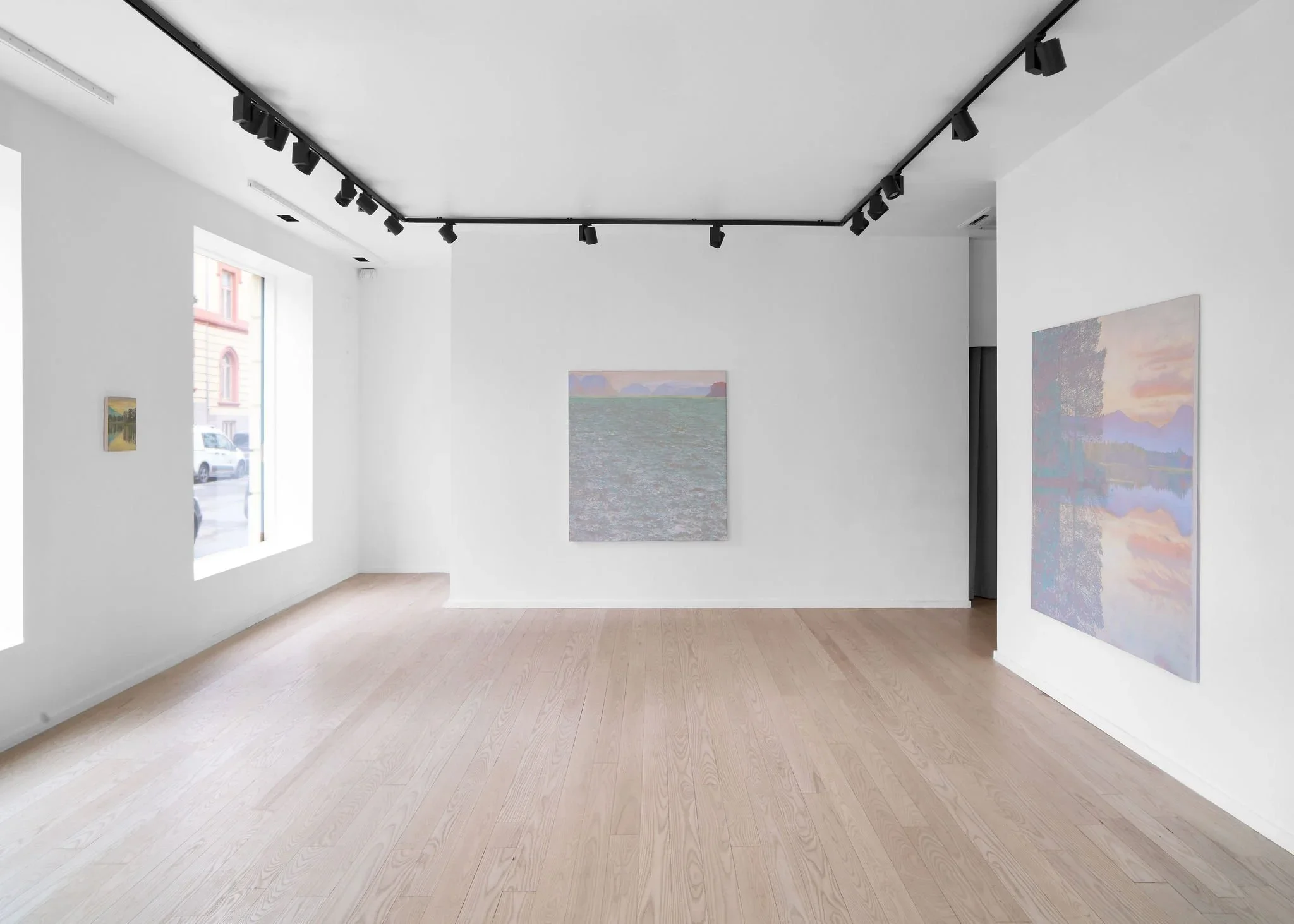
Water is never neutral. It gathers, presses, and exceeds its edges. It holds memory and reshapes what contains it. In The Weight of Water, Martine Poppe approaches water as both subject and structure - shifting, unstable, reorganising ground, perception, and scale.
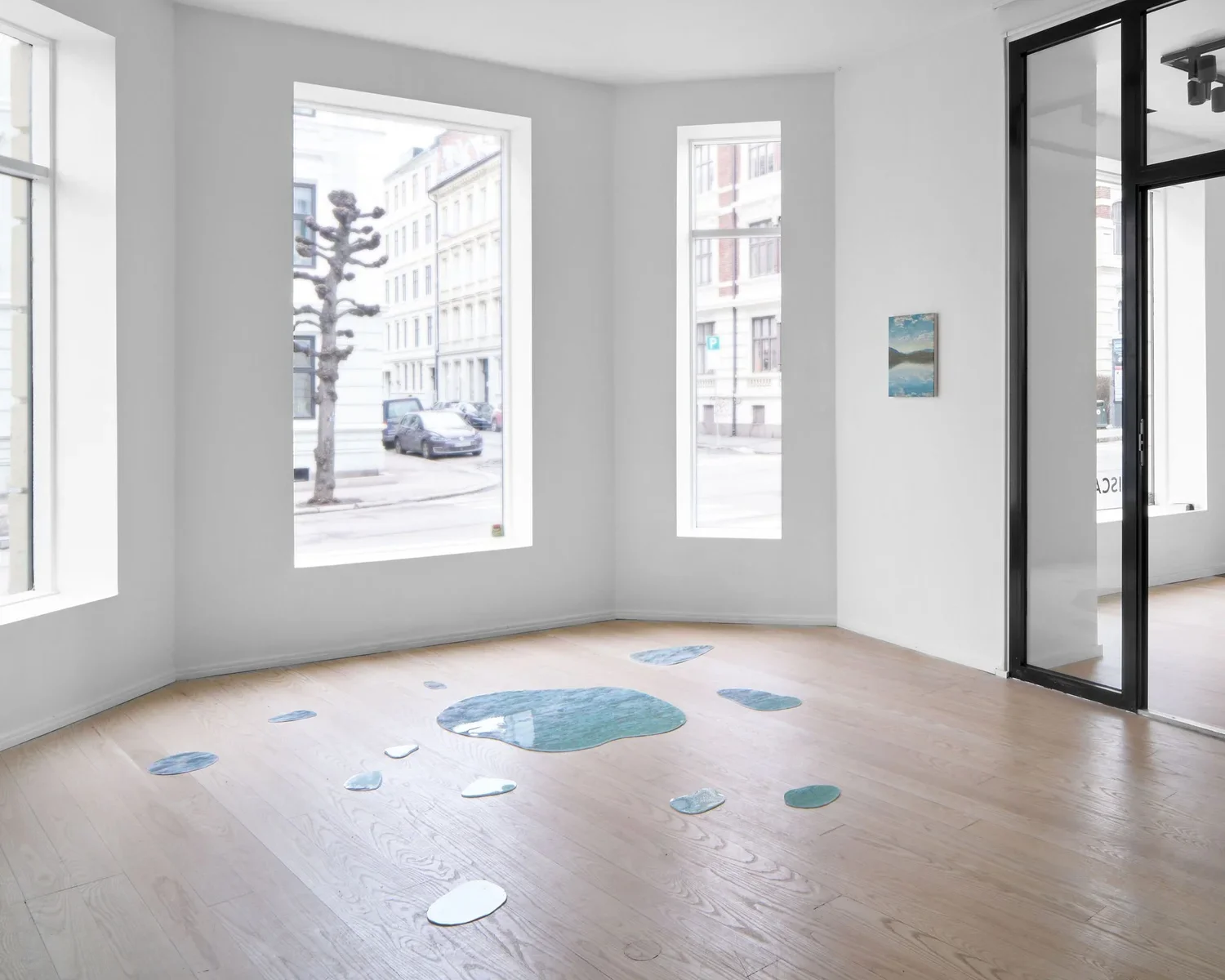
The paintings trace movement through landscape: roads travelled, places remembered, time compressed into terrain. As the exhibition unfolds, water gradually dominates the canvas. Human presence is implied only through absence: droplets on a windshield give way to lake reflections that unsettle orientation. In the final works, depth collapses into surface with waves filling the canvas and land reduced to a narrow strip.
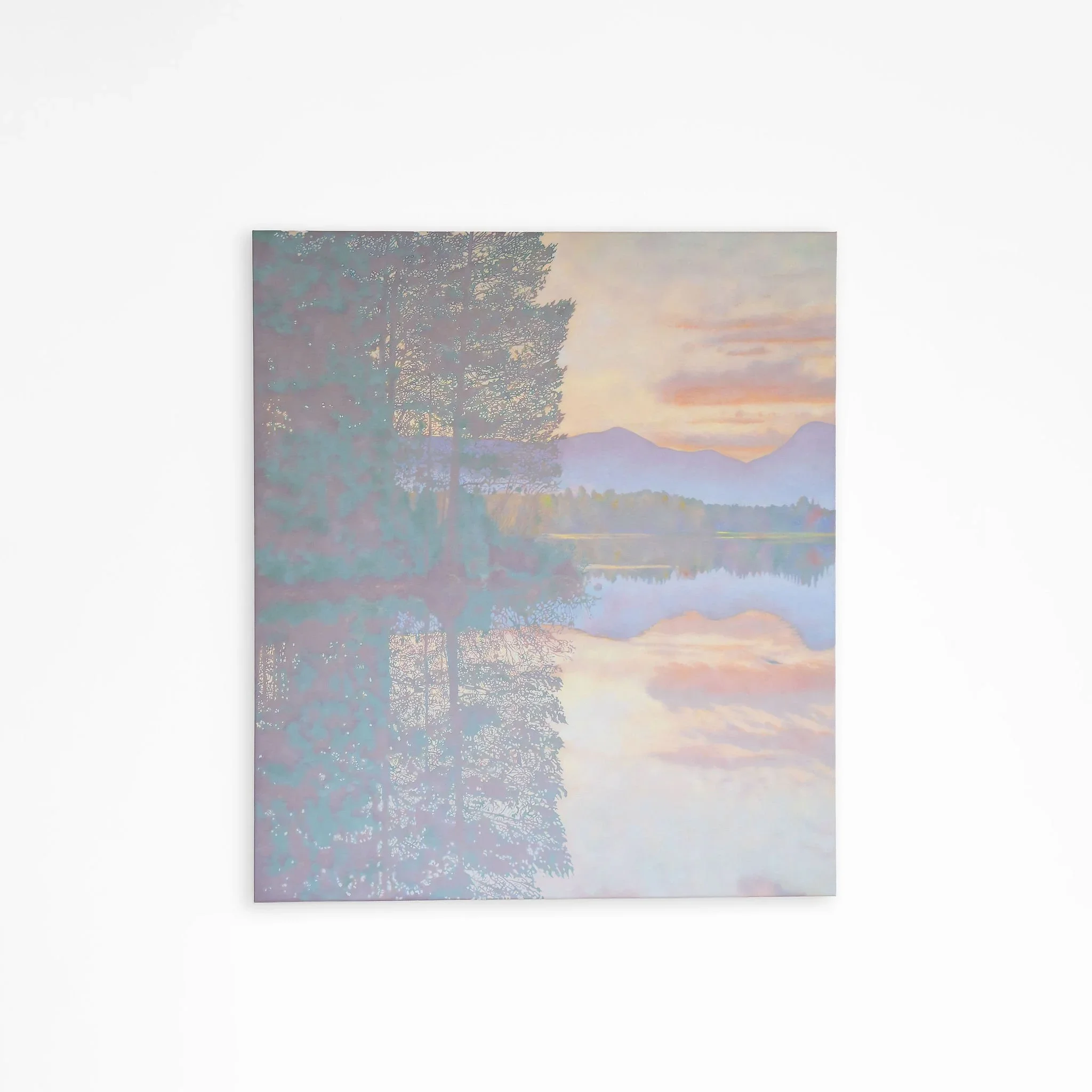
Painted in a single layer on translucent sailcloth, the works merge surface and depth. Pale colours and receding horizons reflect a landscape increasingly experienced through screens. Up close, the images dissolve into light and brushwork; at a distance, they come into focus.
The exhibition resonates with historical depictions of water, from Klimt’s lakes and Monet’s ponds to Hiroshi Yoshida’s coastal views and Scandinavian seascapes, while echoing contemporary literary reflections on rising waters and ecological fragility in Frederick Turner, Kim Stanley Robinson, and Iida Turpeinen. Together, the works reflect on perception, precarity, and the shifting ground between lived experience and its afterimage.
Martine Poppe (b. 1988, Norway) lives and works in London and Oslo, and graduated from the Slade School of Fine Art BA and MFA in 2011 and 2013 respectively. Poppe's works are developed from the fluidity between the different materials she employs, negotiating the boundaries between abstraction and representation.
Recent solo exhibitions include East of the Sun and West of the Moon, Kristin Hjellegjerde Gallery, London, UK (2025); The Earth in Search of Magic Tidings, Kristin Hjellegjerde Gallery, Nevlunghavn, Norway (2023); Peering at the Edge of Daydreams, Kristin Hjellegjerde Gallery, Berlin, Germany (2023); Pause, COUNTY, Palm Beach, Florida, USA (2021); A Piece of Me, Kristin Hjellegjerde Gallery, London, UK (2021); To Be Announced, Buer Gallery, Oslo, Norway (2021); Zima Blue, Kristin Hjellegjerde Gallery, Berlin, Germany (2020); Waiting for Y, Kristin Hjellegjerde Gallery, London (2019); Portraits of Trees, Trafo Kunsthall, Asker, Norway (2018–2019).
Poppe has received numerous esteemed grants and awards, including grants from The Association of Norwegian Visual Artists in 2025, Ingrid Lindbäck Langaards Stiftelse in 2021 and 2022, the Young Artist Grant from the Norwegian Arts Council (2017), and the Juvenarte Prize in Norway (2010 and 2011). She was also shortlisted for the East London Painting Prize in 2015. Collections that feature Poppe’s work include the UK Government Art Collection (UK), KODE Museums (Norway), the Saatchi Collection (UK).
ISCA Gallery
ISCA Gallery is an independent contemporary art gallery and project space with the goal of supporting, exhibiting and promoting Norwegian and Scandinavian artists both locally and internationally.
The gallery opened in June 2020 in the center of Oslo and features an exhibition program developed with emerging and established artists from the nordic countries and abroad.
ISCA Gallery aims to support and cultivate the art community in Oslo and bring international exposure to artists through gallery exhibitions, art fairs and collaborations.
Meltzersgate 12
0257 Oslo
Wednesday - Friday: 12.00 - 17.00
Saturday: 12.00 - 16.00
Monday - Tuesday: By appointment
The gallery does not review unsolicited submissions from artists.
Þorgerður Ólafsdóttirs - Future Remains
Welcome to the exhibition opening on Thursday 16 April at 6:00 PM.
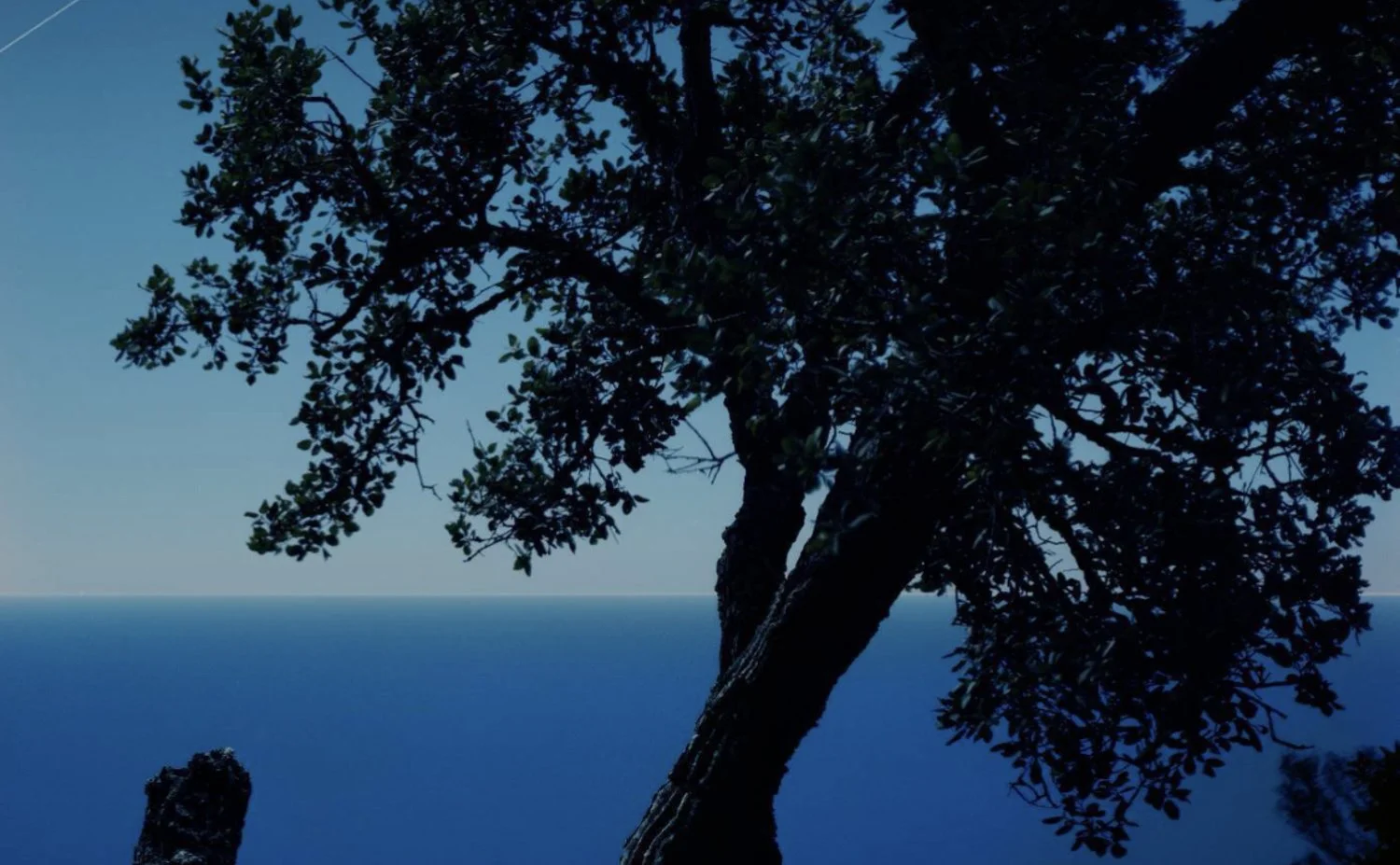
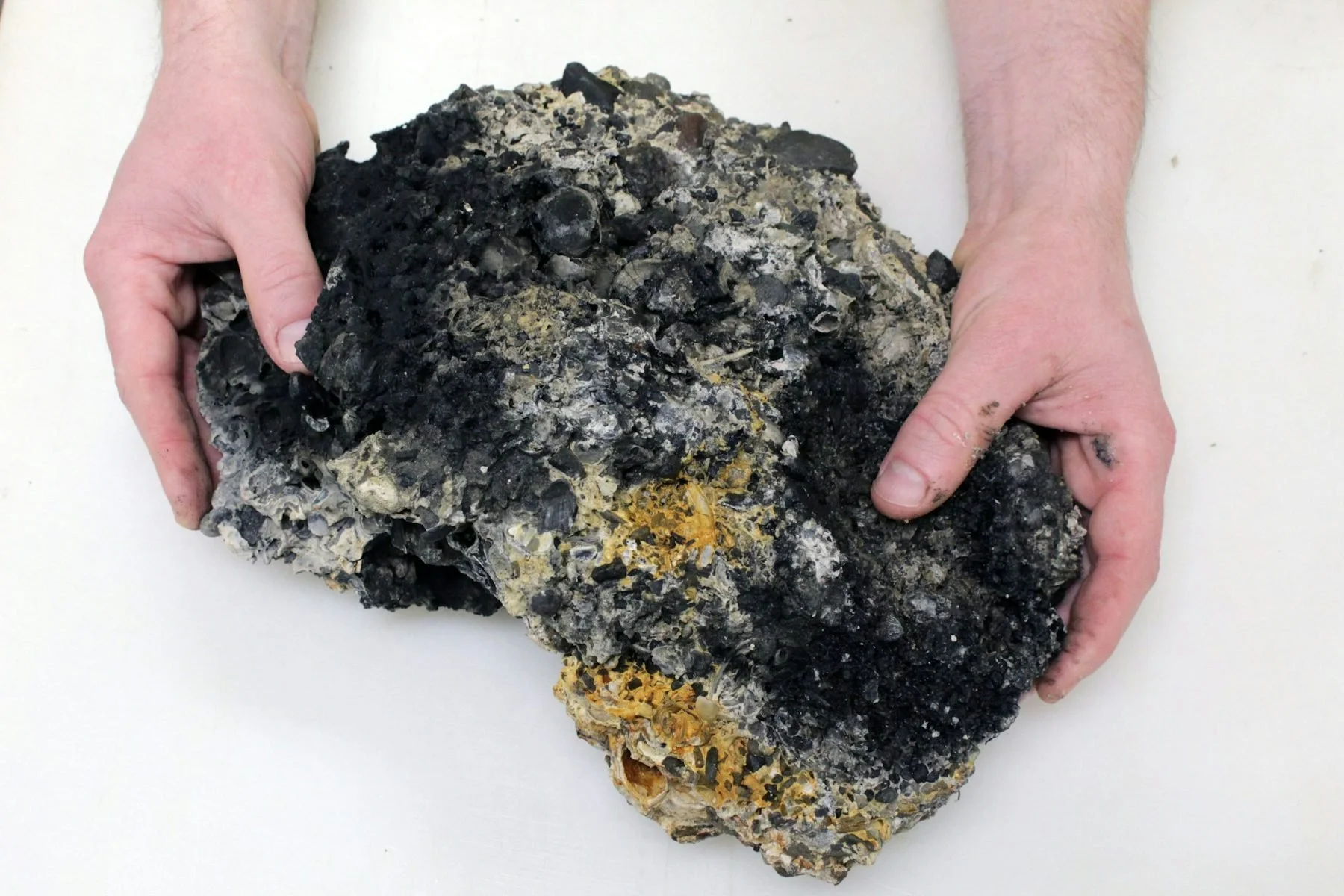
The exhibition Future Remains by Icelandic artist Þorgerður Ólafsdóttir offers insight into the artist’s ongoing exhibition and research project exploring our relationship and connection to nature in a changing world. Ólafsdóttir is interested in the intersection between natural and cultural heritage and how these influence one another. At Atelier Nord she presents new video works, photographs and textile pieces, together with a collection of natural samples, persistent artefacts and other markers of the Anthropocene.
From Volcanic Island and Seabed to Glacier and Birch Forest
Ólafsdóttir’s artistic practice involves an active engagement with the places she visits. In this exhibition the public can experience works resulting from her research journeys. Examples include documentation of repeated trips to the volcanic island of Surtsey, records of the seabed from her expedition on the research vessel Kronprins Haakon that crossed the Barents Sea from Svalbard, and samples such as ice cores from Iceland’s largest glacier and a submerged birch forest.
Fieldwork and Research Projects
Through collaborations with institutions like the Icelandic Institute of Natural History, the Environment Agency of Iceland, and the National Museum of Iceland, Þorgerður has helped broaden the scope of scientific fieldwork and archival material. She has twice been granted permission to travel to the volcanic island of Surtsey – formed in an eruption between 1963 and 1967 and inscribed on the UNESCO World Heritage List since 2008. Her stays on Surtsey have had a profound impact on her artistic practice. In 2023 she published the book Iceland Fiction with Relics of Nature, which brings together artworks and essays expanding our ideas about, and connection to, this remote island, as well as the relationship between natural and cultural heritage.
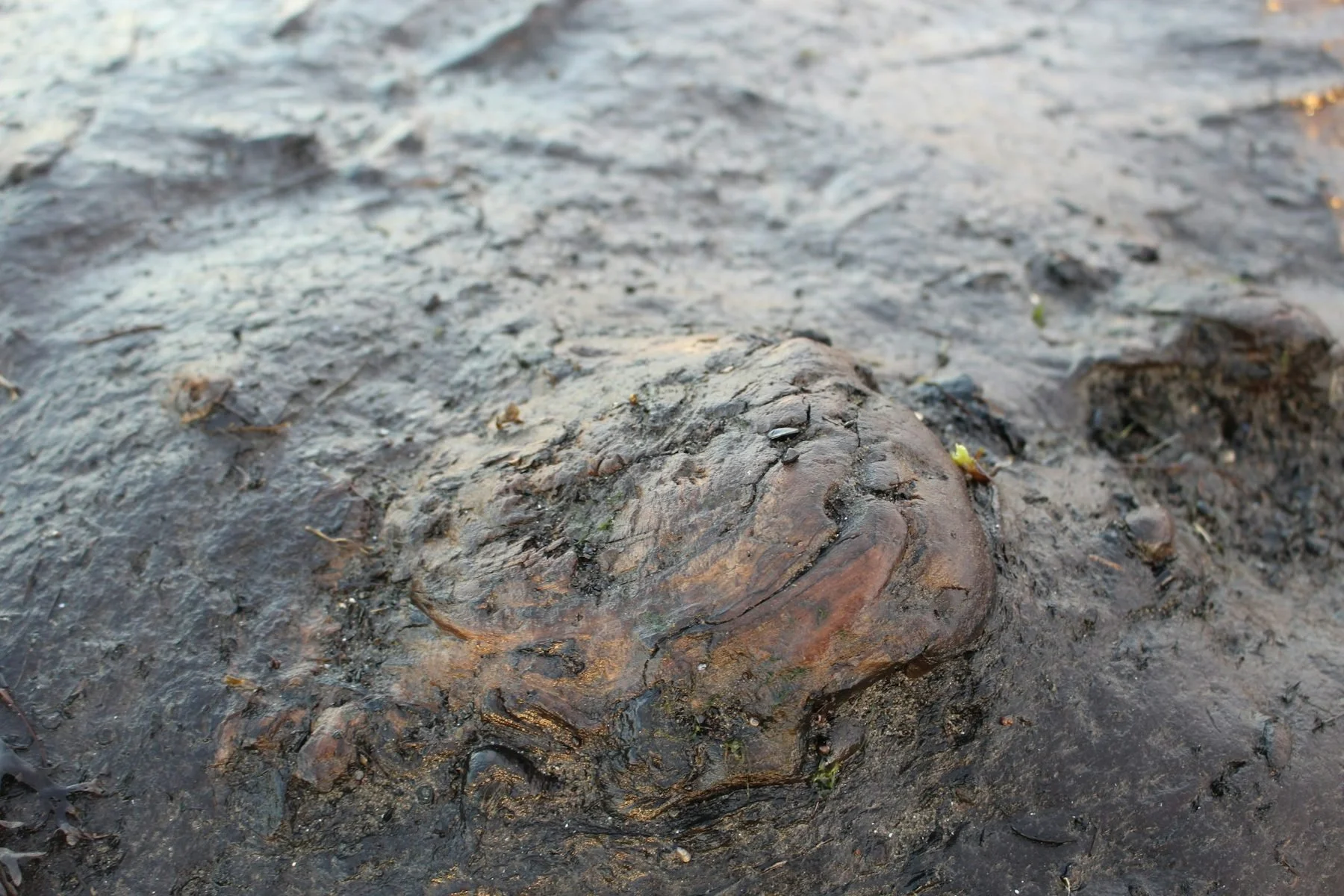
She also takes part in two interdisciplinary research projects: Extremes at the Arctic at the University of Tromsø and Relics of Nature – an Archaeology of Natural Heritage in the High North at the University of Oslo.
About Þorgerður Ólafsdóttir
Þorgerður Ólafsdóttir (born 1985) holds a Master of Fine Art from the Glasgow School of Art and a BA from the Iceland University of the Arts. Her work has been shown at MASP (São Paulo Museum of Art, Brazil), the National Museum of Iceland, Sequences Art Festival (Reykjavík, Iceland), Reykjavík Art Museum, Artierranti (Bologna, Italy), Scandinavia House (New York, USA), Catalyst Arts (Belfast, Northern Ireland), Demon’s Mouth (Oslo, Norway), and Glasgow International, among others. Þorgerður Ólafsdóttir is based in Reykjavík.
The exhibition is supported by Rannis – The Icelandic Centre for Research and Nordic Culture Fund.
Visiting Atelier Nord
Atelier Nord is a venue for contemporary art focused on media art. We present a varied programme of exhibitions, artist talks and workshops, and offer free residencies for professional visual artists in our sound and video editing studios.
Address: Olaf Ryes plass 2, Oslo (entrance from Sofienberggata). Opening hours: Thursday/Friday 15–18, Saturday/Sunday 12–17. Contact: +47 23 06 08 80, office@ateliernord.no.
Tegnerforbundets utvalgte 2025
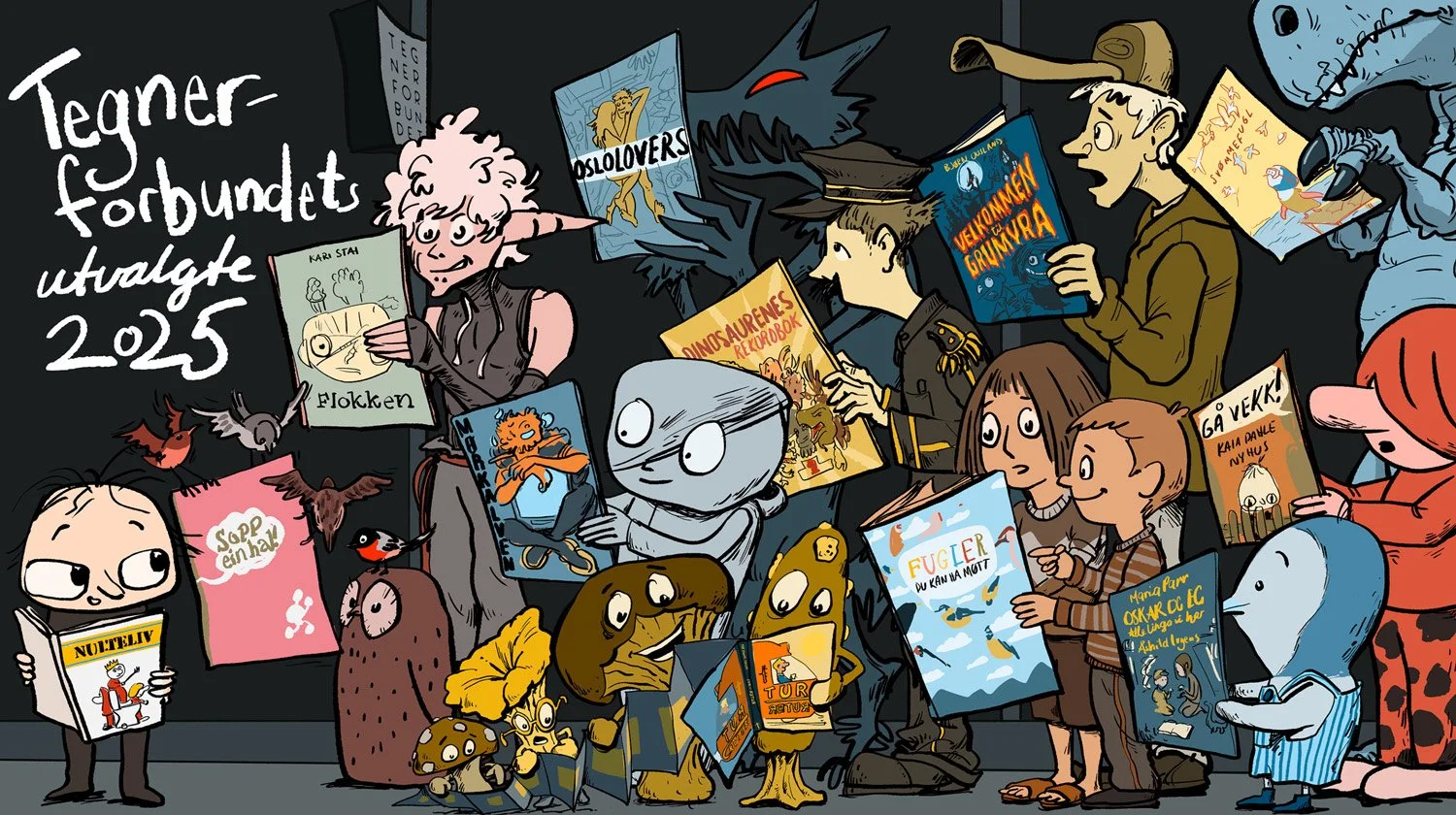
The exhibition presents a professionally juried selection from the great variety of picture books, comics, and illustrated and wordless books published during the past year….
Sebastian Helling - Melee
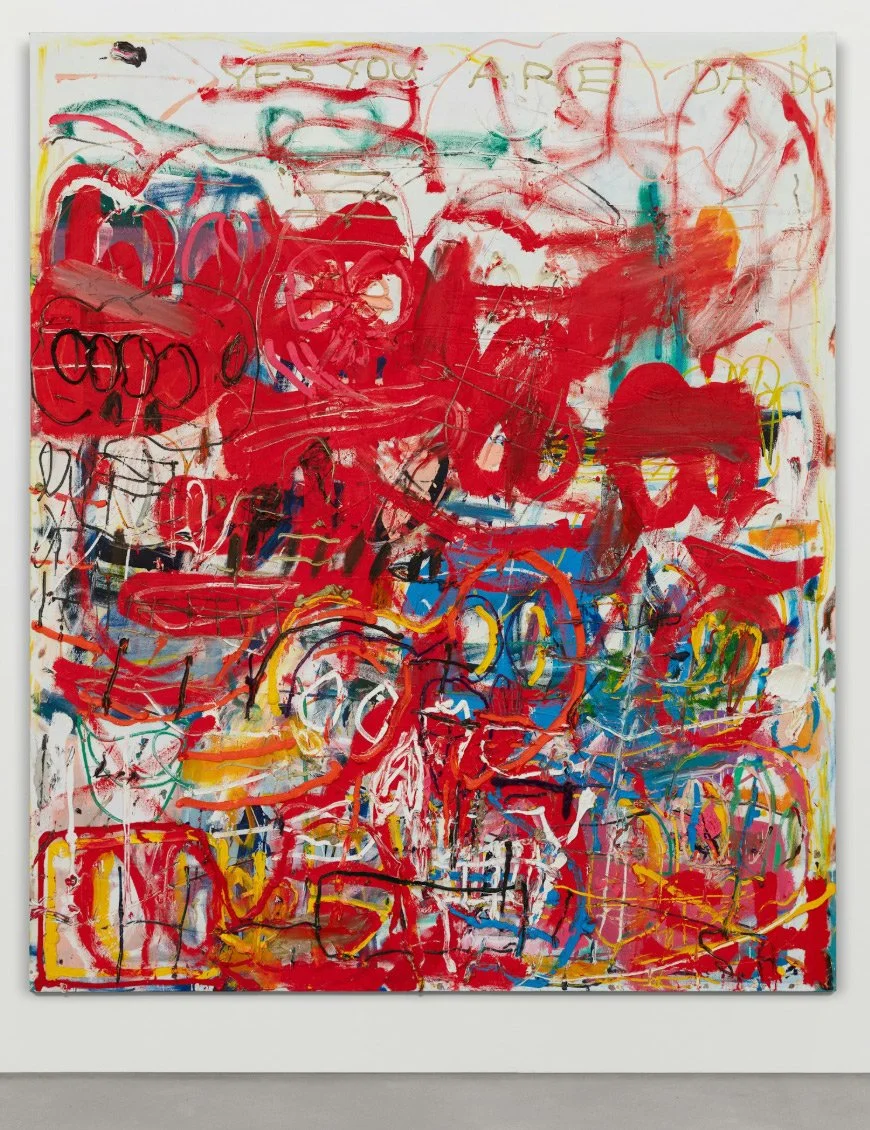
Melee is a word of collision and closeness. A moment of combat, when distinctions blur - bodies, gestures, colors, and intentions….
Anne-Marte Før Eit gøyme (A Hiding Place)
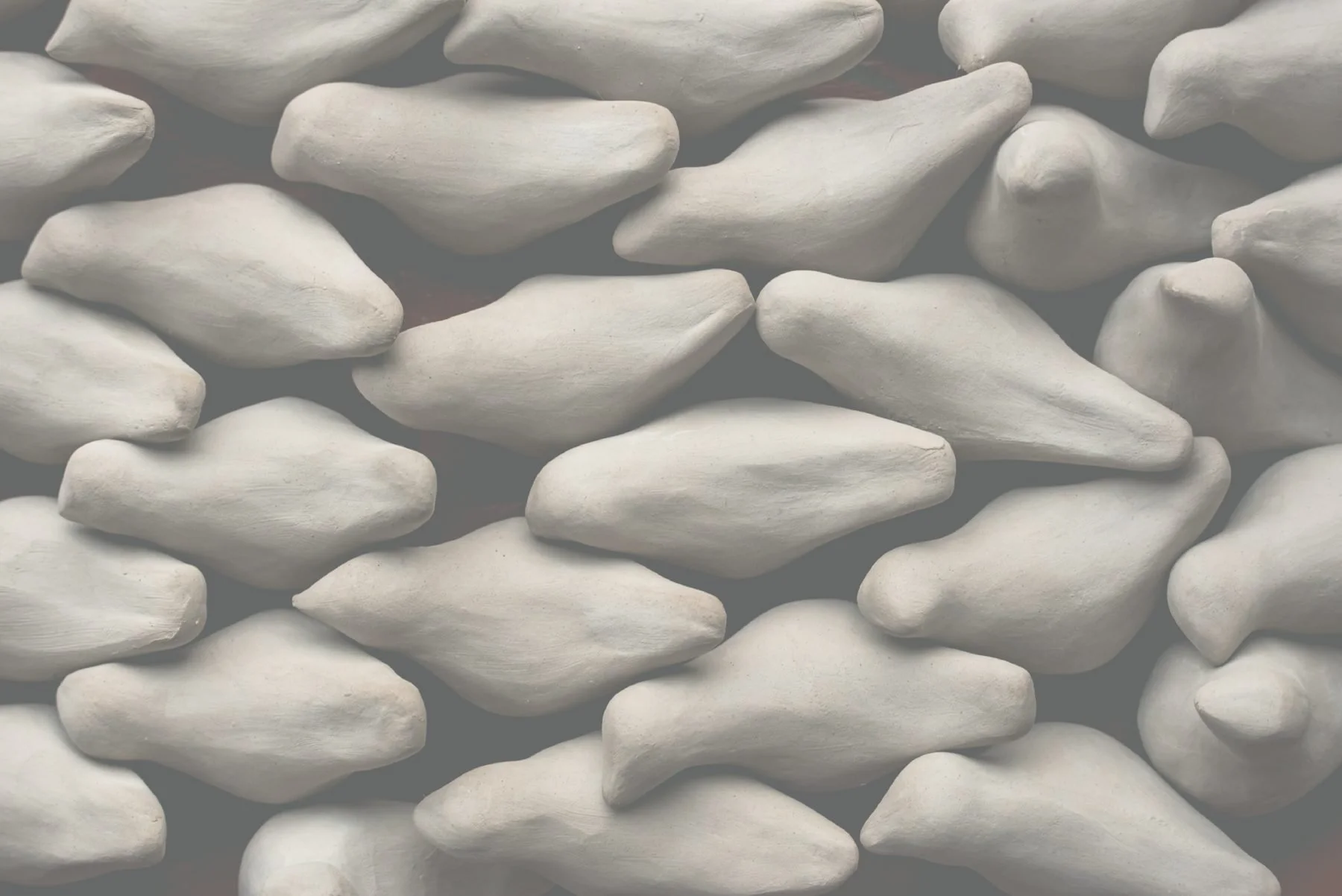
…objects that have moved through landscapes and been of use through winters and springs….
Håkon Bleken
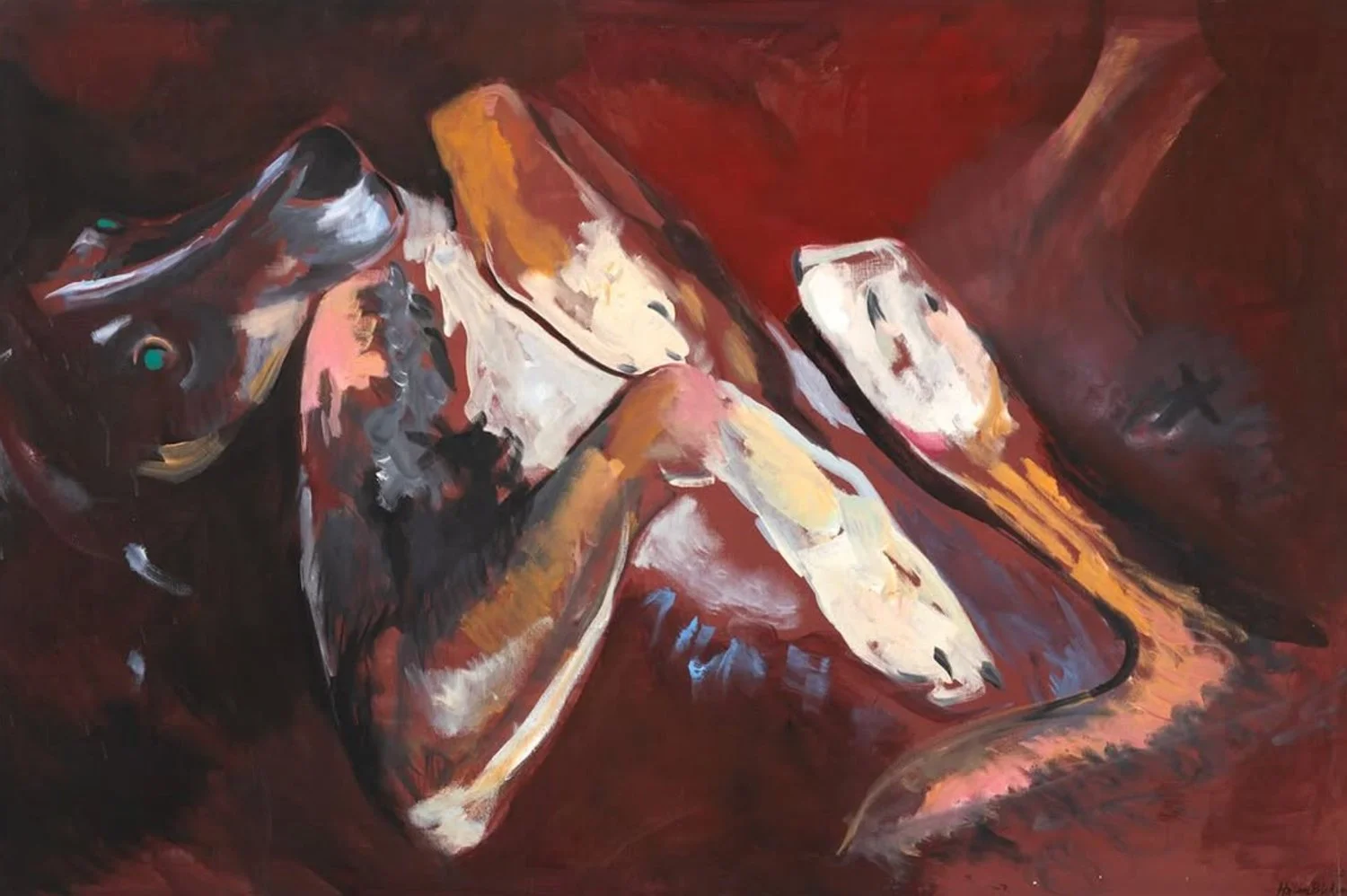
The exhibition “Slik vi husker deg” coincides with the first anniversary of the artist’s passing and will be on view until 7 February 2026……